interactive

  • Mapping the drug wars in Mexico

    February 1, 2012 to Mapping by Nathan Yau

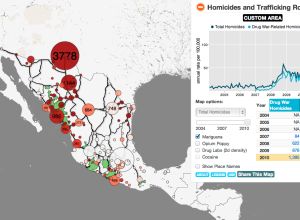
    Drug War Map

    Diego Valle-Jones maps homicides and trafficking routes in Mexico.

    To unclutter the map and following the lead of the paper Trafficking Networks and the Mexican Drug War by Melissa Dell, I decided to only show the optimal highways (according to my own data and Google Directions) to reach the US border ports from the municipalities with the highest drug plant eradication between 1994 and 2003 and the highest 2d density estimate of drug labs based on newspaper reports of seizures. The map is a work in progress and is still missing the cocaine routes, but hopefully I'll be able to add them shortly.

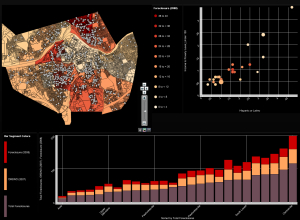
    There's lots to look at and interact with here. To start, there are bubbles that cluster homicides by region and major highway routes in black.

    Click on any bubble and you get a time series for the corresponding area, going back to 2004. Or if you like, draw your own polygon to see the time series for specific regions. Pointers on the time series highlight significant events. There's also a slider that lets you see numbers on the map for different years. A layer underneath the bubbles lets you see high density areas for marijuana, opium, and drug labs.

    Take a look at the full map for yourself. This is nice work by Valle-Jones.

    [Diego Valle-Jones | Thanks, Diego]

  • In perspective: One hour of video uploaded to YouTube per second

    January 24, 2012 to Infographics by Nathan Yau

    Babies per second

    YouTube surpassed the one hour of video uploaded per second threshold recently. To put that rate into perspective, they launched a fun illustration-based site, One Hour Per Second. Big team effort headed by Punk & Butler, illustrations by Alex Eben Meyer, animation by Justin Young, and development by Use All Five.
    Continue Reading

  • SOPA opposition surges

    January 20, 2012 to Infographics by Nathan Yau

    sopa-opera-count-scaled

    ProPublica has been tracking members of Congress who oppose and support SOPA. You can view by party and chamber, and you can even sort by campaign contributions from movie, music, and television. Above shows the quick change from January 18 to 19.

    [ProPublica]

  • Members Only
    Area charts

    Build Interactive Time Series Charts with Filters

    When you have several time series over many categories, it can be useful to show them separately rather than put it all in one graph. This is one way to do it interactively with categorical filters.
  • Bach Cello Suites visualized

    December 8, 2011 to Data Art by Nathan Yau

    As a resident at Eyebeam, Alexandar Chen visualizes the first Prelude from Bach’s Cello Suites:

    Using the mathematics behind string length and pitch, it came from a simple idea: what if all the notes were drawn as strings? Instead of a stream of classical notation on a page, this interactive project highlights the music’s underlying structure and subtle shifts.

    Interaction version here. Charming.

    [Alexander Chen via @blprnt]

  • Rise and fall of riot rumors on Twitter

    December 7, 2011 to Network Visualization by Nathan Yau

    Rumors

    During the riots in London this past summer, a lot of information spread quickly about what was going on. Some of that information was true and some was not so true. The Guardian explores this spread of information on Twitter, and how fact and fiction seem to reveal themselves on their own:

    A period of unrest can provoke many untruths, an analysis of 2.6 million tweets suggests. But Twitter is adept at correcting misinformation - particularly if the claim is that a tiger is on the loose in Primrose Hill.

    Other rumors include when rioters cooked their own food at McDonald's (false), London Eye was set on fire (false), and Miss Selfridge was set on fire (true).

    Each bubble represents a tweet and is sized by number of followers the tweeter has. The big one is usually the orignal tweet and the small ones that cluster around are retweets. Then the colors represent tweets that support, oppose, question, or comment. So when you play the animation for each rumor, bubbles swiftly pop up at the rumor peaks and then settle at true or false.

    You can also use the scroll to move to a certain point in time, and roll over bubbles to see the tweets.

    Really nice graphic and worth a look.

    [Guardian via @jakeporway]

  • US road fatalities mapped, 9 years

    November 29, 2011 to Mapping by Nathan Yau

    Road fatalities

    For The Guardian, ITO World maps about 370,000 road-related deaths from 2001 through 2009, according to the National Highway Traffic Safety Association. The map is kind of rough around the edges, but it gets the job done. Easily zoom in to the location of choice either by clicking buttons, or type in the area you want in the search box. Zoom in all the way, and you'll notice each accident is represented by an icon indicating type of accident, the age of the person who died, and year of crash.

    As you might expect, accidents are more concentrated at city centers and on highways. What I didn't expect was all the pedestrians involved.

    [Guardian and ITO World]

  • What topics science lovers link to the most

    November 23, 2011 to Network Visualization by Nathan Yau

    What science lovers link to

    Hilary Mason, chief scientist at bitly, examined links to 600 science pages and the pages that those people visited next:

    The results revealed which subjects were strongly and weakly associated. Chemistry was linked to almost no other science. Biology was linked to almost all of them. Health was tied more to business than to food. But why did fashion connect strongly to physics? And why was astronomy linked to genetics?

    The interactive lets you poke around the data, looking at connections sorted from weakest (fewer links) to strongest (more links), and nodes are organized such that topics with more links between each other are closer together.

    Natural next step: let me click on the nodes.

    [Scientific American via @hmason]

  • Who owes what to whom in Europe

    November 22, 2011 to Network Visualization by Nathan Yau

    Eurozone debt web

    As the Eurozone crisis develops, the BBC News has a look at what country owes what to whom:

    Europe is struggling to find a way out of the eurozone crisis amid mounting debts, stalling growth and widespread market jitters. After Greece, Ireland, and Portugal were forced to seek bail-outs, Italy - approaching an unaffordable cost of borrowing - has been the latest focus of concern.

    But, with global financial systems so interconnected, this is not just a eurozone problem and the repercussions extend beyond its borders.

    Simply click on a country, whose arc length represents how much they owe, and arrows show debt.

    [BBC News | Thanks, Eugene]

  • Public opinion of the Occupy movement

    November 18, 2011 to Infographics by Nathan Yau

    Occupy Movement Opinion

    To get a gauge of public opinion and the Occupy movement, The New York Times asked readers what they they thought, placing their comments on a two-axis grid ranging from strongly disagree/oppose to strongly agree/support.

    On the horizontal: "Do you agree or disagree with the main goals of the Occupy Wall Street movement?" On the vertical: "Do you support or oppose the methods of the protestors?" So comments on the top right are those who strongly agree with the goals of the movement and strongly approve of protestors' methods. You can also color the dots and grid spots based on a range of disagree to agree for statements such as "Income inequality has contributed to the country's problems."

    Then to bring it home, comments are listed on the bottom with a small grid showing where that person selected. Put it all together and it's way more useful than just open threads elsewhere.

    [New York Times]

  • American migration map

    November 17, 2011 to Mapping by Nathan Yau

    American migration

    Overhauling his migration map from last year, Jon Bruner uses five year's worth of IRS data to map county migration in America:

    Each move had its own motivations, but in aggregate they ­reflect the geographical marketplace during the boom and bust of the last decade: Migrants flock to Las Vegas in 2005 in search of cheap, luxurious housing, then flee in 2009 as the city’s economy collapses; Miami beckons retirees from the North but offers little to its working-age residents, who leave for the West. Even fast-growing boomtowns like Charlotte, N.C., lose residents to their outlying counties as the demand for exurban tract-housing pushes workers ever outward.

    Compared to last year's map, this one is much improved. The colors are more subtle and more meaningful, and you can turn off the lines so that it's easier to see highlighted counties when the selected county had a lot of traffic during a selected year. Speaking of which, you can see map the data for 2005 through 2009 via the simple bar graphs in the top right.

    Update: Jon also explains how he built this map sans-Flash on his own blog.

  • Politilines shows what candidates talk about during debates

    November 11, 2011 to Network Visualization by Nathan Yau

    Politilines by Periscopic

    If you don't watch the candidate debates — and let's face it, that's just about everyone — you pretty much miss everything, except for stuff like Rick Perry forgetting agency names. Politilines, by Periscopic, lets you see what the candidates talked about each night.

    The left column lists top issues, the middle shows words used, and the right column shows candidates. Roll over any word or name to see who talked about what or what was talked about by whom.

    The method:

    We collected transcripts from the American Presidency Project at UCSB, categorized them by hand, then ranked lemmatized word-phrases (or n-grams) by their frequency of use. Word-phrases can be made of up to five words. Our ranking agorithm accounts for things such as exclusive word-phrases - meaning, it won't count "United States" twice if it's used in a higher n-gram such as "President of the United States."

    While still in beta, the mini-app is responsive and easy to use. The next challenge, I think, is to really show what everyone talked about. For example, click on education and you see Newt Gingrich, Ron Paul, and Rick Perry brought those up. Then roll over the names to see the words each candidate used related to that topic. You get some sense of content, but it's still hard to decipher what each actually said about education.

    [Politilines]

  • 7 billion people in the world: past, present and future

    October 31, 2011 to Mapping by Nathan Yau

    World population

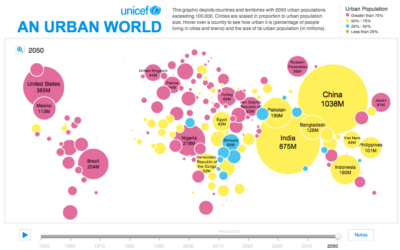
    According to estimates from the United Nations Population Division, there are now over seven billion people in the world. That's enough people to fill, like, an entire room. Yeah. Visualization firm Bestiario, for The Guardian, shows this growth by country, using their home-brewed visual programming language, Impure.

    There are a few options to play with. You can click on the bubble for a country to see the time series on the bottom for population from 1950 to 2010, through a projected 2100 population. Life expectancy for the same range is also shown. To compare geographically, you can also choose the year filters in the bottom right to compare, say, population in 1950 to that of 2010.

    India and China of course pop out in that range, whereas many African populations are expected to increase a lot, percentage-wise, during the next century.

    [The Guardian]

  • Google+ Ripples show influence and how posts are shared

    October 27, 2011 to Network Visualization by Nathan Yau

    Google+ Ripples

    Posts and links get shared over and over again, but we usually don't know how. We get counts, but who shares what and how far do does a link reach? Google+ Ripples gives you a peak into the process. A link or status is posted, and like when a pebble is dropped in a pond, a pattern forms outwards.
    Continue Reading

  • Visualizing Yahoo email in real-time

    October 13, 2011 to Visualization by Nathan Yau

    United States Yahoo Mail

    Hundreds of thousands of emails are sent every second, and yet, you wouldn't really know it because there aren't public-facing streams like that of Twitter. Outside your own inbox, how much email is there exactly? Yahoo, in collaboration with information visualization firm Periscopic, shows you how much email they process in real-time with this interactive feature.
    Continue Reading

  • Life expectancy

    Life expectancy changes

    I played around with D3 some more. This time I used data from The World Bank to look at life...
  • Kill Math makes math more meaningful

    October 5, 2011 to Statistical Visualization by Nathan Yau

    Kill Math

    After a certain point in math education, like some time during high school, the relevance of the concepts to the everyday and the real world seem to fade. However, in many ways, math lets you describe real life better than you can with just words. Designer Bret Victor hopes to make the abstract and conceptual to real and concrete with Kill Math.
    Continue Reading

  • Submarine cable system connecting the world

    October 3, 2011 to Mapping by Nathan Yau

    Submarine cable map

    TeleGeography maps underwater cables that connect countries and continents:

    TeleGeography’s free interactive submarine cable map is based on our authoritative Global Bandwidth research, and depicts 188 active and planned submarine cable systems and their landing stations. Selecting a cable route on the map provides access to data about the cable, including the cable’s name, ready-for-service (RFS) date, length, owners, website, and landing points. Selecting a landing point provides a list of all submarine cables landing at that station.

    Just imagining cables that stretch that far seems pretty amazing.

    [Thanks, Harvey]

  • The Fortune 500, 1955 to 2010

    September 28, 2011 to Statistical Visualization by Nathan Yau

    The Fortune 500 Profits

    Since 1955, Fortune Magazine has published a list of America's 500 largest companies. What companies have risen to the top? Which ones have fallen? Ben Fry, of Fathom Information Design, visualizes the companies of past and present and how their rankings, revenue, and profit have changed.
    Continue Reading

  • How Americans spend their day -full

    How do Americans spend their days?

    One of my favorite data graphics is an interactive piece by The New York Times that shows how Americans spend...
Unless otherwise noted, graphics and words by me are licensed under Creative Commons BY-NC. Contact original authors for everything else.