Design

  • Sketching Around Personal Brand Tracking

    October 3, 2008 to Design  •  Nathan Yau  •  Share on Twitter

    Sketching Around Personal Brand Tracking

    This is a guest post by Miguel Jiménez, a user experience and interaction designer based in Madrid.

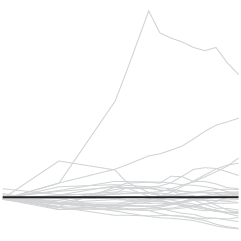
    There's a lot of noise today around Personal Branding and constructing your own self as a global brand on a certain topic. It makes complete sense to increase your professional value reflecting on others and using the Internet to build up this reputation. It's said that you should start by creating an online identity, supposedly to reflect your Real World™ one, with an entry point in the form of a blog or similar. That's a nice introduction and it’s quite easy to implement, but the main problem to the process of constructing a self-brand is monitoring and tracking how your efforts perform and the next steps you should take. So let's have a conceptual look and sketch around the statistical data found nowadays in the Internet.
    Continue Reading

  • Playful Infographics Triumph Over Pure Analytics (Sometimes)

    July 7, 2008 to Design, Infographics  •  Nathan Yau  •  Share on Twitter

    Playful Infographics Triumph Over Pure Analytics (Sometimes)

    The New York Times shows how presidential candidates have spent more than $900 million so far with this bubbly graphic by Lee Byron, Hannah Fairfield and Griff Palmer. The area of a circle represents the amount of money spent in any particular category. For example, the biggest chunk of funds ($337 million) was spent on media and consulting.

    I know what a lot of you are thinking and are maybe even about to write something in the comments - "Bubbles suck at showing amount. Bars are much easier to read." Some might even be thinking about a pie chart in lieu of the bibbly bobbilies. Here's what I have to say: the bubbles are fun, so mission accomplished. That is all.

  • Why Should Engineers and Scientists Care About Color (and Design)?

    April 29, 2008 to Design  •  Nathan Yau  •  Share on Twitter

    Why Should Engineers and Scientists Care About Color (and Design)?

    I studied electrical engineering and computer science in undergrad and now as a stat student, I still work with a lot of engineers and scientists. Something that has always confused me as I walk through the engineering (and statistics) halls of conference posters is the use of the rainbow color scale.
    Continue Reading

  • A Little Bit of Design Goes a Long Way With Infographics

    March 27, 2008 to Data Art, Design  •  Nathan Yau  •  Share on Twitter

    A Little Bit of Design Goes a Long Way With Infographics

    If I've learned anything about designing information graphics, it's that attention to detail and small changes make a mediocre graphic into a really useful and usually more attractive one. It's what sets New York Times graphics apart from those in other publications and especially those in academic papers. Something like a short annotation can add context or a line shifted slightly to the left can make data look less cluttered.
    Continue Reading

  • A Chat with The New York Times on Making Data More Engaging

    January 29, 2008 to Design  •  Nathan Yau  •  Share on Twitter

    Jared Pool had a chat with Andrew (multimedia) and Steve (graphics) at The New York Times. I'm sure you're familiar with their work. They chat about the design process of the interactive pieces on The Times site like the transcript analyzer, the home run chart, and plenty of other specific examples. They also go into a bit about where they get inspiration from (e.g. old Fortune magazines, photographs, advertisements) as well as how they go about creating their more innovative pieces.

    Keep in mind it's on the User Interface Engineering blog, so it's mostly focused on, well, the user interaction and design and less on where data comes from, the journalistic process, etc, but still, it's a pretty good listen.

    [via Visual Methods]

  • Symbiosis of Engineering, Statistics, Design and Data Visualization

    January 4, 2008 to Design  •  Nathan Yau  •  Share on Twitter

    Andrew Vande Moere writes in his 2005 paper Form Follows Data:

    [W]e can perceive a current trend in portable input and output devices that trace, store and make users aware of a rich set of informational sources. So-called ubiquitous computing is moving into the direction of location-based information awareness, enabling users to both access and author dynamic datasets based upon a geographical context through electronic communication media.

    With this growing trend of streaming data in mind, Andrew goes on to say

    Building automation services enable spaces to react to dynamic, physical conditions or external data sources in real time. Currently, these interactions are programmed by engineers, and imply simple action-reaction rules, such as the control of lights, security or climate control: what would be possible if these tools are offered to designers, concerned with the emotional experience of people?

    If you're an engineer, you might be wondering, "Hey! Why can't I design ambient systems? I care about emotional experience too. Somewhat. Sort of." As someone who majored in electrical engineering and computer science and still works with a lot of engineer types, I will tell you why. Engineers are generally not very good at the visual display of data. To engineers, the most beautiful part of a data visualization installation might be the hardware, elegant code, or the hours spent tweaking the system's logic. Engineers are fascinated with the guts of the system.

    Continue Reading

  • Bars as an Alternative to Bubble Charts

    October 22, 2007 to Design  •  Nathan Yau  •  Share on Twitter

    beers-and-bars

    Are bubble charts effective? This seems to be a recurring question. Some say people suck at comparing areas in the form of bubbles, or rather, people are horrible with areas, period. Others argue that it just takes some getting used to; the eye has to be trained, and once that's done, the bubbles are good to go.

    In any case, here is an alternative to the bubbles -- bars. The beer data from a previous post are charted (2006 shipments on the left, and 2005 shipments on the right). The advantage of bars over bubbles is that users only have to compare heights; however, numbers are going to clutter quickly as more observations are added.

    People should just train their eyes. Bubbles are so much more fun. They're bubbly.

  • John Maeda Speaks About Simplicity

    September 22, 2007 to Design  •  Nathan Yau  •  Share on Twitter

    John Maeda, a professor in the MIT Media Lab, gives his talk on simplicity and how it plays a role in his position between technology and art. I read John's book, The Laws of Simplicity, a few months ago, and yes, as many will tell you, it's a pretty simple book. There are ten laws of simplicity that boil down to the main point -- get rid of everything that's unnecessary and nothing more. Although nothing earth-shattering, John's book makes some good points and has some interesting anecdotes from his many trips to Japan and family life; it's a nice read for some lazy Sunday. He's also a pretty entertaining speaker, so sit back, relax, and enjoy yet another TED talk.

  • Displaying Data as Efficiently as Possible

    September 12, 2007 to Design  •  Nathan Yau  •  Share on Twitter

    filling-space

    The above picture isn't totally related, but I just had to put it up. It's so amusing. A family of five plus groceries on one motorcycle! I think there's room for one more on the handle bars.

    So in efforts to make the above picture relevant...

    If I've learned anything during my internship, it's how to display as much information as possible in a small amount of space. Two things have helped me in trying to achieve New York Times graphics department worthiness:

    • Decide what data / information is important
    • K.I.S.S. -- Keep it simple, stupid. (The Office, Thursdays on NBC)

    Decide What Data is Important

    When you get a large data set, your first impulse might be to show all of it. For some cases, like exploratory data analysis (EDA), this is what you want. However, when you're trying to show off results or display some kind of idea, then you might not need to point to all 100,000 values in your data set. Instead, evaluate all the data you have and then ask yourself what interesting thing in the data you're trying to show.

    Keep it Simple

    Once you've established what the point is, make sure your graphic draws attention to that point. Don't clutter with giant labels or overly bright colors that overpower your graphic's main idea. For example, if you look at a bar graph, I don't think the labels should be the first thing you notice. Rather, you should notice the bars, the real meat of the graphic, first and then recognize the labels second.

    Oh, and don't forget about white space.

    Super busy graphics are just plain hard to read. Let the data breathe.

    I guess my main point is that you can try to display as much information as possible in a small amount of space, but if you're not careful and put too much, your motorcycle will tip over. See what I did there the whole motorcycle idea? You know, full circle. Circle of life. Hakuna matata. Oh forget it.

  • Creating Effective Visualization

    June 25, 2007 to Design  •  Nathan Yau  •  Share on Twitter

    What makes a visualization good? It allows people to see what they never would have seen otherwise? It's pretty? The visualization is interactive? Simple? Probably all of the above, and yeah, it's probably common sense, but... why is there so much bad viz out there?

    Perhaps people don't have the skills to create effective visualization. I, myself, don't yet possess the necessary skills to create great viz, so that's definitely a limiting factor. Whether it's in Flash, Processing, or whatever, honed skills is essential.

    In my eyes, the more serious problem, is that some don't have the eye or logic for good viz. It's great when the user can interact with the data, but if the user interface sucks, then the viz fails. Viz can easily get very complicated as we build, add more features, and eventually forget what our primary goal was in the first place.

    When the user has a viz tool she can use, then it's at this point, the viz should show the user something they never expected (or confirms a suspicion -- although I like the idea of surprise). From here, the user can decide what she wants to do, but it's my hope that anything I create will make people aware of their surroundings and motivate change in a positive direction.

    I feel like I'm rambling...

    So yeah, um, effective visualization -- expertise, simplicity, mind-blowing factor.

Copyright © 2007-2012 by FlowingData. Hosted by Media Temple.