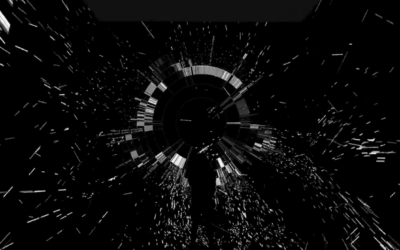
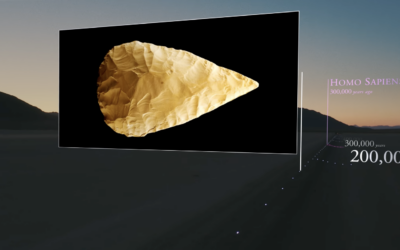
This holographic video by Bruce Branit is completely fictional but oh so sexy. Can you imagine a digital world at that level of interaction - where just about anything and everything is at your finger tips? It's good to dream.
[via infosthetics]

This holographic video by Bruce Branit is completely fictional but oh so sexy. Can you imagine a digital world at that level of interaction - where just about anything and everything is at your finger tips? It's good to dream.
[via infosthetics]

Information Architects, a design firm with offices in Japan and Zurich, release their annual web trends map. This is the fourth one in the series. Popular domains on the Web are mapped to the Tokyo Metro and organized by how they are most related to the cities. Heights represent success in traffic and branding. Subway lines are colored by area of interest. For example, take the orange line to find the creatives. Notice that there are several colors passing through Apple.
Here's the high-res zoomable version. Go full-screen for the full effect.
While the map would mean a lot more to me if I lived in Tokyo, the designers obviously have taken great care to cover the details, and that's something I can appreciate.
[via TechCrunch | Thanks, Pavan and Max]

Aaron Koblin and Daniel Massey team up to give us Bicycle Built for Two Thousand, an Amazon Mechanical Turk rendition of Bicycle Built for Two. They used custom software written in Processing to record 2,088 voices. Put together all those random voices, and you get this:
For 6 cents, turkers were asked to imitate a sound bite and were not told why they were doing so. What they were actually singing was a note from "Daisy Bell," originally written by Harry Dacre in 1892, or otherwise known as the first song sung by a computer in 1962. The full song is interesting, but it's even more amusing listening to the individual (dorky) voices singing the separate notes. Ehhhhh... wahhhh... eeeeeee... haha.
[via infosthetics]

Data Flow: Visualizing Information in Graphic Design isn't an Edward Tufte book. It's not an instruction manual nor is it a guide to analytical and statistical graphics. Rather, Data Flow is a showcase of visualization and infographics with a hard focus on aesthetics and form.
Continue Reading

Stamen Design, whose work you've most definitely seen, comes out with their most recent collaboration with Flickr, the photo and video sharing service. It's called Flickr Clock. It lets you browse Flickr videos contributed to the Flickr Clock Group Pool. Videos are arranged as slices by time uploaded (or is it time contributed to the group?) and sized by their original upload resolutions. Click on a slice, and the video opens up like above.

Underneath is a time browser for a zoomed out view with chunks by the hour. Click, drag, and browse or just sit back and let autoplay do the work for you if you're too lazy to move your mouse. The wider the chunks are, the more videos that were uploaded during the hour.

Flickr Clock isn't my favorite Stamen work (that title still belongs to Cabspotting), but I like it. It's fun. What do you think about Flickr Clock?

In collaboration with generative artists Marius Watz, field, and others, along with Universal Everything and Wieden+Kennedy, Nokia has put together a beautiful art series involving communication as a promotion to their new E71 smartphone. The series include two interactive pieces and several videos.
One interactive piece takes video from your webcam, audio from your mic, and text that you type as input to create a generative art piece that you can send to friends and download as desktop wallpaper. Here's what mine looks like:

The gray blobbies are from me waving my arm around, the blue waves are from me whistling, and the text strands are from me typing "welcome to the jungle" in the input box. It's pretty fun to play with.
The second one is a small (and pretty elegant) application that you download onto your E71. Use the application to send a text message and along with that message comes a generated image that looks something like the first image in this post. It'll be different bits of art as you send different messages.
Then there are the videos - all interesting and beautiful on their own:
Great stuff.
By the way, I have the Nokia E71. It's an awesome phone, in case you're looking for a Blackberry alternative. Awesome design and really good feel to it. The GPS has helped guide me many many times and the keypad makes typing easy, which is perfect for my little self-surveillance project.
[Thanks, Sermad]

Google's chief economist tells us statistician will be the sexy job of the next decade. Now Microsoft provides its vision for 2019 (video below):
The future for 2019 looks a lot like data visualization and some serious data processing, yeah? So you better get ready. Hop on to the band wagon before all the seats are taken. The future sure is lookin' good. Check out the extended version of the above video in the link below.
[via istartedsomething | Thanks, dx0ne]

Seed Magazine, a publication dedicated to cool things in science, give us The Universe in 2009:
In 2009, we are celebrating curiosity and creativity with a dynamic look at the very best ideas that give us reason for optimism. Rethink your assumptions and post better questions about the future.
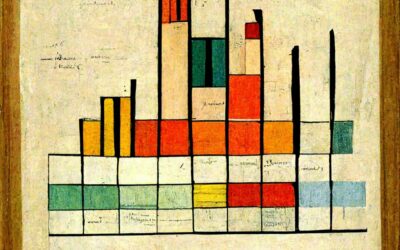
The Universe in 09 is essentially a simple mosaic where each tile is an idea. There's something that resembles a bar graph up top. Each bar represents a category, and as you scroll over a category, the height of the bar represents the numbers of ideas in that category (I think). It's not meant to be analytical really. It's mostly for fun, and they did a pretty good job at accomplishing that goal. The interaction is pretty entertaining. Check it out for yourself.

Linda Eckstein sent this graphic along to show the main ideas of Russ Baker's Family of Secrets. In Linda's words, "[T]he idea was for me to come up with a visual representation of the scope and complexity of Baker's book. In a way, it's the unWordle. Wordle only analyzes what is said, sometimes it's necessary to remind the public of what is NOT said."
From Vanity Fair:
The editors of VF.com, fascinated by the concentric circles of intrigue and coincidence that connect the Bushes to various nerve centers, nefarious and benign, commissioned information designer Linda Eckstein to concoct a graphic device that would serve as a sort of 21st century Power Crib Sheet. Consider it a modern-day version of those 1960s and 70s conspiracy theory flow charts that sought to drag the apparatus of the oligarchs, the generals, and the spooks out of the shadows. The result is this VF.com exclusive, a loopy, labyrinthine Family of Secrets bullseye—part eye chart, part pie chart, part Otto Preminger-esque movie poster for the Bush-whacked masses.
[Thanks, Linda]

Some of the best stuff comes out of student projects. During the Screendesign workshop in Fachhochschule Potsdam last summer, students were asked to collect, analyze, and visualize personal data. Topics ranged from haircuts to movie consumption to telephone habits. The assignment was largely inspired by Nick Felton's Feltron Report:
I loved every single issue of the Feltron annual report. From the first time I saw it I was convinced it was a great topic for a personal project – or for a university course. So the project setting became "personal annual report". Since a long time, I’m interested in visualization methods from journalistic infographics to scientifc information visualisation – so I’m convinced it’s a great and important topic to encourage people getting involved with. And it is a field that never stops evolving, where you are never about to reach the ground, no matter how deep you dive (yeah, this is for interactive media or even media in general, but it feels stronger to me when it comes to data visualization).
I really like to see courses like this centered around visualization and then the results from some inspired students. It goes to show how this area is growing. I just wish I got to take these types of courses.
[Thanks, Christophe]

Remember Twistori? It's the Twitter mashup that shows tweets of love, hate, think, believe, and wish. I guess naturally, there's an inauguration version. It's not as effective, but still worth a look.

People have fallen in love with word clouds that make pictures. Zoom in and you see a bunch of individual words. Zoom out and you see a famous person's face. It is a dictionary or a portrait? Mystical. TBWA/Chiat/Day, an advertising agency in Nashville, Tennessee of all places, brings the concept to promotion for the 2009 Grammy Awards - in animated form. Float through the cloud of songs and lo and behold, it's Stevie Wonder.
It's only a matter of time until someone creates the next version of Wordle. Let people upload a picture and some words and then charge people a few bucks for a printed poster. It'd be a huge hit. It's the perfect gift I tells ya. I'm looking at you, Jeff. We need to talk.
[via uncovering data]

In his latest data sculptures, Andreas Nicolas Fischer places data visualization in a physical space when we're so used to seeing it on a computer monitor. Above is a piece of two layers - the bottom is gross domestic product for 2007 (made of plywood) and the top maps "the derivatives volume, alloted to the coordinates of the countries on a map." I don't know what derivatives volume and I probably should, but I'm too lazy to look it up (a lil' help please?).
From the project page:
This sculpture is a statistical map, a hybrid between physical and conceptual space. The horizontal arrangement equates to the Mercator projection of a world map and the vertical axis metaphorically corresponds to the financial activity of the country.
Similarly, Andreas displays the S & P 500, Dow Jones, and NASDAQ prices in 2008 from January to November:


Evan Roth from the Graffiti Research Lab, uses typographic illustration in Jay-Z's music video for Brooklyn Go Hard. As the song plays out, we see sketches of Jay-Z drawn using Brooklyn (sort of what we saw from Jeff at Neoformix). It's quite the work of art:
You can download the source code for the video from Evan's site, which is pretty cool too.
[via Animal | Thanks, Max]

This is a guest post by Greg J. Smith, a Toronto-based designer and researcher. Greg writes about design, visualization and digital culture on his personal blog Serial Consign.
A few weeks ago the second edition of the Visualizar workshop wrapped up at Medialab-Prado in Madrid. In curating the event this year, organizer José Luis de Vicente selected urban informatics as the focus of research and visualization development. Partially inspired by Cascade on Wheels (a project created at the workshop last year), the Visualizar mandate was in line with contemporary thinking about the city where the street is viewed as a platform and urban space is considered a DIY enterprise. Visualizar'08 brought together a range of programmers, designers, architects, illustrators and scholars to participate in a seminar on contemporary thinking about the city and then bunker down to "rapid prototype" seven visualization projects over a two-week period.
These visualizations provide a range of strategies for representing urban space and address issues of mobility, perception, the environment and flows of information. Each of these interfaces is proof positive that urban cartography is rapidly evolving and (more importantly) open to reconsideration by a motivated citizenry. Although each of these projects is credited to a singular author or collective it has to be noted that this work was produced by groups of up to a dozen collaborators - more info on these teams is available at the site for each project. Input and guidance came from guest lecturers Aaron Meyers, Bestiario, Fabien Girardin, Adam Greenfield and Juan Freire.
Taking advantage of the data generated by Barcelona's community bicycle program Bicing, BCNoids aims to explore the movement of 6000 bikes across a network of 400 stations. Developed in VVVV, the research draws inspiration from Craig Reynolds' 1980s experiments with simulated flocking behviour and aspires to deliver "a tool for the analysis of human mobility patterns".

Providing environmental information on agents which include synthetic chemicals, neurotoxins and bioaccumulative toxic substances, Ecovisualiacion is an interactive system for representing the levels of various pollutants. Working at multiple scales, this Processing application displays emissions from various EU capital cities (noting potential health risks), acts to "spatialize the dynamic behavior" of these substances and tracks concentrations at a molecular scale.

The city of Madrid currently tracks air quality through a network of sensors distributed throughout the city. This allows for the monitoring of pollutants such as sulfur dioxide, carbon monoxide and ozone at sites of traffic congestion and public interaction. In the Air uses this data to provide a (Processing-powered) realtime index of the air quality and a highly customizable interface for examining historical data. This visualization was simultaneously developed alongside a prototype of a diffuse facade - an experiment in using architecture as an ambient display for environmental information.

Delving into the realm of subjective experience, Much Ado About Nothing utilizes noise pollution data from Madrid City Council to create virtual spaces in which to explore and discover the character and quality of sounds created at specific sensor stations. The resulting panoramic interface provides an immersive experience coupled with a graphic overlay that displays the intensity (in decibels) and source of each noise.

Finding inspiration in the question "Have you ever thought of urban space as seen through the eyes of the media?", Murmur proposes an alternate means of mapping Madrid. Fed by a stream of more than 600 RSS feeds, this Actionscript/PHP application creates several models for "media geography" which geolocate, aggregate and abstract the flow of information from major media outlets and the blogosphere.

Maps are often founded on the misguided notion that their end-users are all equally mobile. Lazarillo GPS proposes a system for mapping areas of "cultural interest" in Madrid for the physically disabled. Armed with GPS receivers and disabled test subjects, the Lazarillo team went out into the city and conducted field research to serve as the basis for a custom notational system which maps accessibility in several tourist districts.

Picking up on the momentum of the 2004 research project Critical Cartography of the Strait of Gibraltar, Cartography of the Strait proposes a visualization of the "migratory, economic, political and cultural flows" between southern Europe and northern Africa. This research saw the prototyping of a 3D environment for representing these sociopolitical flows which is currently under development.
Big thanks to Greg for the detailed recap of Visualizar. Subscribe to Serial Consign to read more from Greg.