Design

  • Visualizing data: ask a question first

    April 29, 2010 to Design, Quotes  •  Share on Twitter  •  Comments (3)

    There is no way to think up an original and extraordinary design—it can only come as a result of pursuing a given task. In the same way running down a list of words is different from making a narrative.

    — Artemy Lebedev, Designer’s block, February 16, 2010

    This applies to visualization too. When you don't have a question to answer or a simple wonderment about something, you end up staring at a bunch of numbers with no clue what to do with them. Want to test this out? Go to data.gov and make something useful.

    [via @Coudal]

  • Graphical perception – learn the fundamentals first

    Before you dive into the advanced stuff - like just about everything in your life - you have to learn the fundamentals before you know when you can break the rules.
  • Think like a Statistican

    Think like a statistician – without the math

    I call myself a statistician, because, well, I'm a statistics graduate student. However, the most important things I've learned are less formal, but have proven extremely useful when working/playing with data.
  • 11 Ways to Visualize Changes Over Time – A Guide

    January 7, 2010 to Design  •  Share on Twitter  •  Comments (32)

    Deal with data? No doubt you've come across the time-based variety. The visualization you use to explore and display that data changes depending on what you're after and data types. Maybe you're looking for increases and decreases, or maybe seasonal patterns.

    This is a guide to help you figure out what type of visualization to use to see that stuff.
    Continue Reading

  • 9 Ways to Visualize Proportions – A Guide

    November 25, 2009 to Design  •  Share on Twitter  •  Comments (35)

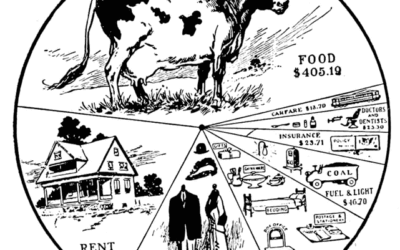
    With all the visualization options out there, it can be hard to figure out what graph or chart suits your data best. This is a guide to make your decision easier for one particular type of data: proportions.

    Maybe you want to show poll results or the types of crime over time, or maybe you're interested in a single percentage. Here's how you can show it.
    Continue Reading

  • Chart Junk vs. Eye Candy: What’s the Difference?

    September 25, 2009 to Design  •  Share on Twitter  •  Comments (20)

    There's this one phrase that really bothers me when it comes to data graphics. No doubt you've heard it or read it, and maybe it even popped into your head once or twice.

    The phrase I'm talking about is: "Edward Tufte is crying."

    People like to say this when they see a graphic that doesn't fit the ET law of high data/ink ratio. Then after the commenter has declared that ET is in fact a very emotional man, the graphic is classified "chart junk."

    First off, I'm pretty sure ET isn't that melodramatic. He doesn't cry over a bad graph nor does he die a little inside or roll over in his grave if he were dead. I don't think an angel get its wings every time he rings a bell either. Although I could be wrong about the latter.

    Second, not everything that fails to fit the mold of a traditional graph, visualization, or whatever you want to call it, is chart junk. One person's chart junk is another person's eye candy. What you see just depends on what angle you're looking at it from.
    Continue Reading

  • What Visualization Tool/Software Should You Use? – Getting Started

    September 3, 2009 to Design  •  Share on Twitter  •  Comments (54)

    toolAre you looking to get into data visualization, but don't quite know where to begin?

    With all of the available tools to help you visualize data, it can be confusing where to start. The good news is, well, that there are a lot of (free) available tools out there to help you get started. It's just a matter of deciding which one suits you best. This is a guide to help you figure that out.
    Continue Reading

  • Important Data – Please Act Responsibily

    July 20, 2009 to Design  •  Share on Twitter  •  Comments (11)
    drunk
    Photo by nyki_m

    Data visualization and infographics come in many forms. Some are comical and purely made for entertainment. Others are made for decisions, and important decisions at that. Let's focus on the latter right now.

    To make educated decisions based on graphics, you need accurate ones, and to make accurate graphics, you need a full understanding of the data.

    If you don't know about the data - the context of where it came from or how it was collected - your visualization or infographic is simply a data comic that could potentially misinform its readers.
    Continue Reading

  • 6 Easy Steps to Make Your Graph (Really) Ugly

    June 15, 2009 to Design  •  Share on Twitter  •  Comments (49)

    We spend so much time trying to make our graphs accurate, simple, understandable, etc that we forget the lost art of making graphs that are inaccurate, unreadable, make absolutely no sense, and make your eyes want to vomit. I'm so tired of understanding data. I want to experience it, and I know you want to also.

    So this one's for you, crappy graph.
    Continue Reading

  • Rise of the Data Scientist

    June 4, 2009 to Design, Statistics  •  Share on Twitter  •  Comments (47)

    Photo by majamarko

    As we've all read by now, Google's chief economist Hal Varian commented in January that the next sexy job in the next 10 years would be statisticians. Obviously, I whole-heartedly agree. Heck, I'd go a step further and say they're sexy now - mentally and physically.

    However, if you went on to read the rest of Varian's interview, you'd know that by statisticians, he actually meant it as a general title for someone who is able to extract information from large datasets and then present something of use to non-data experts.
    Continue Reading

  • Visual Representation of Tabular Information – How to Fix the Uncommunicative Table

    April 21, 2009 to Design, Network Visualization  •  Share on Twitter  •  Comments (34)

    Visual Representation of Tabular Information – How to Fix the Uncommunicative Table

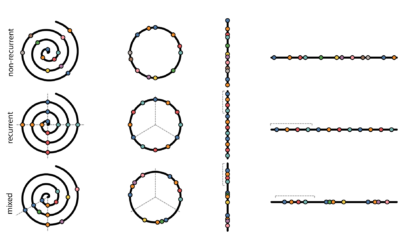
    This is a guest post by Martin Krzywinski who develops Circos, a GPL-licensed (free) visualization tool that can help you show relationships in data. This article is based on a longer writeup which you can find here.

    Suppose that you are reading an article and the text refers you to a table on the next page. Before you turn the page, what are your expectations of the table? Chances are, you would like it to communicate trends and patterns. Chances are, too, that it will fail and simply deliver numerical minutiae. You are left hunting around the numbers for a while, only to return to the text in hopes that the table's data trends will be communicated elsewhere.
    Continue Reading

  • Data Visualization is Only Part of the Answer to Big Data

    March 20, 2009 to Design, Exploratory Data Analysis  •  Share on Twitter  •  Comments (8)

    How can we now cope with a large amount of data and still do a thorough job of analysis so that we don't miss the Nobel Prize?

    — Bill Cleveland, Getting Past the Pie Chart, SEED Magazine, 2.18.2009

    For the past year, I've been slowly drifting off my statistical roots - more interested in design and aesthetics than in whether or not a particular graphic works or the more numeric tools at my disposal. I've always had more fun experimenting on a bunch different things rather than really knuckling down on a particular problem. This works for a lot of things - like online musings - but you miss a lot of the important technical points in the process, so I've been (slowly) working my way back to the analytical side of the river.
    Continue Reading

  • Flow Chart Shows You What Chart to Use

    January 15, 2009 to Design  •  Share on Twitter  •  Comments (17)

    Flow Chart Shows You What Chart to Use

    Amit Agarwal, of Digital Inspiration, posts this Andrew Abela creates this flow chart that helps you decide, well, what type of chart to use. Start in the middle with what you want to show - comparison, relationship, distribution, or composition - and then work your way out to the number of variables. Pretty timely for our brand new Visualize This project.

    [via Digital Inspiration]

  • One Death is a Tragedy; a Million is a Statistic

    January 9, 2009 to Design  •  Share on Twitter  •  Comments (21)

    Photograph by *Your Guide

    I posted a comic from xkcd last week that implied graphs and data lead to a decline in love. I didn't really think much of it, but Jim commented that an episode from This American Life (episode 88: Numbers), was very much related to the topic of personal data and what we often miss out on as a result. The lead-in to the show reads:

    Numbers lie. Numbers cover over complicated feelings and ambiguous situations. In this week's show, stories of people trying to use numbers to describe things that should not be quantified.

    This reminded me of Joseph Stalin's well known quote, "One death is a tragedy; a million is a statistic." It's a horrible thing to say, but when it comes to data visualization and analysis, it's true a lot of the time. We have a huge dataset and we have to extract information from it. In the process though, we forget that every one of those numbers has real non-numeric value to it. There are emotions and feelings. Life is complex. Data represents life, and therein lies the purpose and meaning of FlowingData.
    Continue Reading

  • Steve Jobs on Design

    October 31, 2008 to Design, Quotes  •  Share on Twitter  •  Comments (2)

    Most people make the mistake of thinking design is what it looks like… People think it's this veneer -- that the designers are handed this box and told, 'Make it look good!' That's not what we think design is. It's not just what it looks like and feels like. Design is how it works.

    — Steve Jobs, The New York Times, 2003

    I post this not because I like Apple products, but because it's true (and because I like Apple products). I'm no designer, but as a statistician, I have tremendous respect for those who are. Have a nice weekend all.

    [via swissmiss]

  • Great Data Visualization Tells a Great Story

    October 10, 2008 to Design  •  Share on Twitter  •  Comments (17)

    Think of all the popular data visualization pieces out there - the ones that you always hear in lectures, read about in blogs, and the ones that popped into your head as you were reading this sentence. What do they all have in common? They probably all told a great story. Maybe the story was to convince us of something, compel us to action, enlighten us with new information, or force us to question our own preconceptions. Whatever it is, truly great data visualization reaches us at a very human level and that is why we remember them.

    Let's face it. Data can be boring if you don't know what you're looking for or don't know that there's something to look for in the first place. It's just a mix of numbers and words that mean nothing other than their raw value. The great thing about statistics and data visualization though is that they provide us with the tools to learn that the data are much more than a bucket of numbers. There are stories in that bucket. There's meaning, truth, and beauty. Sometimes the stories will be simple and other times complex. Some will belong in a textbook; others will come in novel form. It's up to the statistician, computer scientist, designer, or analyst to make that decision.
    Continue Reading

  • Sketching Around Personal Brand Tracking

    October 3, 2008 to Design  •  Share on Twitter  •  Comments (8)

    Sketching Around Personal Brand Tracking

    This is a guest post by Miguel Jiménez, a user experience and interaction designer based in Madrid.

    There's a lot of noise today around Personal Branding and constructing your own self as a global brand on a certain topic. It makes complete sense to increase your professional value reflecting on others and using the Internet to build up this reputation. It's said that you should start by creating an online identity, supposedly to reflect your Real World™ one, with an entry point in the form of a blog or similar. That's a nice introduction and it’s quite easy to implement, but the main problem to the process of constructing a self-brand is monitoring and tracking how your efforts perform and the next steps you should take. So let's have a conceptual look and sketch around the statistical data found nowadays in the Internet.
    Continue Reading

  • Playful Infographics Triumph Over Pure Analytics (Sometimes)

    July 7, 2008 to Design, Infographics  •  Share on Twitter  •  Comments (10)

    Playful Infographics Triumph Over Pure Analytics (Sometimes)

    The New York Times shows how presidential candidates have spent more than $900 million so far with this bubbly graphic by Lee Byron, Hannah Fairfield and Griff Palmer. The area of a circle represents the amount of money spent in any particular category. For example, the biggest chunk of funds ($337 million) was spent on media and consulting.

    I know what a lot of you are thinking and are maybe even about to write something in the comments - "Bubbles suck at showing amount. Bars are much easier to read." Some might even be thinking about a pie chart in lieu of the bibbly bobbilies. Here's what I have to say: the bubbles are fun, so mission accomplished. That is all.

  • Why Should Engineers and Scientists Care About Color (and Design)?

    April 29, 2008 to Design  •  Share on Twitter  •  Comments (3)

    Why Should Engineers and Scientists Care About Color (and Design)?

    I studied electrical engineering and computer science in undergrad and now as a stat student, I still work with a lot of engineers and scientists. Something that has always confused me as I walk through the engineering (and statistics) halls of conference posters is the use of the rainbow color scale.
    Continue Reading

  • A Little Bit of Design Goes a Long Way With Infographics

    March 27, 2008 to Data Art, Design  •  Share on Twitter  •  Comments (26)

    A Little Bit of Design Goes a Long Way With Infographics

    If I've learned anything about designing information graphics, it's that attention to detail and small changes make a mediocre graphic into a really useful and usually more attractive one. It's what sets New York Times graphics apart from those in other publications and especially those in academic papers. Something like a short annotation can add context or a line shifted slightly to the left can make data look less cluttered.
    Continue Reading

Copyright © 2007-2012 by FlowingData. All rights reserved.