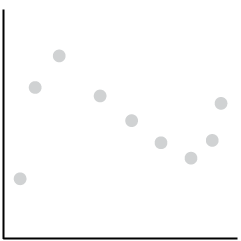
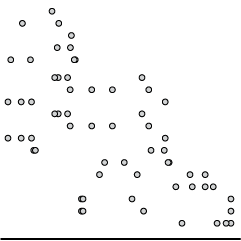
• Congress released a cache of Jeffrey Epstein’s email threads. For the Wall Street Journal, Brian Whitton, John West, and Kara Dapena show name drops through a series of beeswarm charts, with one dot per email thread.

    Not surprisingly, President Trump and former President Bill Clinton are both referenced hundreds of times in what was released this week, according to a Wall Street Journal analysis. Former President Barack Obama’s name appears as well. The Journal’s analysis didn’t identify messages that any of the U.S. presidents wrote directly to Epstein or received emails from him, just references to them by Epstein or his conversation partners.

    There is something to be gleaned, no matter how incomplete the release may be.

  • From the U.S. Public Interest Research Group (PIRG), a safety report on AI-powered toys:

    In our testing, it was obvious that some toy companies are putting in guardrails to make their toys behave in a more kid-appropriate way than the chatbots available for adults. But we found those guardrails vary in effectiveness – and at times, can break down entirely. One toy in our testing would discuss very adult sexual topics with us at length while introducing new ideas we had not brought up – most of which are not fit to print.

    These AI conversational toys also have personalities and new tactics that can keep kids engaged for longer. Two of the toys we tested at times discouraged us from leaving when we told them we needed to go.

    PIRG has released a Trouble in Toyland report each year for the past 30 years. They usually focus on topics like kids swallowing parts or manufacturing that cuts corners. Last year’s report focused on international toys getting through the supply chain even though they didn’t reach U.S. toy standards. So things are moving quick.

    I’m going to let my kids make up conversations with their imagination, thanks. One of the best treats as a parent is to watch a young child throw a party with their stuffed toys. The thought of OpenAI-powered chatbots injecting themselves into the occasion is creepy.

  • In 2024, Hispanic voters in New Jersey took a hard shift to the right compared to 2020 voting. In the recent 2025 election, they shifted back to the left. Christine Zhang and Shane Goldmacher report for the New York Times:

    The Times analyzed data from more than 500 townships in the 19 of New Jersey’s 21 counties where results data was available, accounting for over 90 percent of votes cast in the governor’s race. (Union and Warren Counties have not yet reported township-level results.)

    The two cities that shifted the most toward Democrats were those with the highest percentage of Hispanic voters in the state: Union City and Perth Amboy.

    The maps show a mirror image. A bubble chart also suggests townships with a higher Hispanic population shifted back more towards Democrat.

  • As you might imagine, the word “democracy” has been mentioned in Congressional speeches many times, but over the past several years it has grown much more common to speak about democracy as under threat. For the Pudding, Alvin Chang analyzed speeches in the Congressional Record dating back to 1880, highlighting the abrupt shift in sentiment.

  • Jon Bois of Secret Base is working on a documentary that covers the history of charging the mound in Major League Baseball. Data had to be collected manually, and Bois has shared the results.

    Behind each and every one of my documentary series is a mountain of research documents, notes, and links that never see the light of day. This time around, I’ve decided not only to make my primary research doc open to everybody, but to do so while I’m still working on the project. […]

    That’s all yours. It belongs to you. Browse it, click the links to review the tape, download it, whatever you wanna do. If you’re so inclined, you can even use it as a jumping-off point to produce a story of your own.

    Fields include level of altercation from verbal to full physical takedowns and the level of teammate involvement.

    This is a very important dataset.

  • Drawing inspiration from early cartographers who had to make maps with limited information, Outside Text tested models on world map output, also with limited information.

    In the earliest renditions of the world, you can see the world not as it is, but as it was to one person in particular. They’re each delightfully egocentric, with the cartographer’s home most often marking the Exact Center Of The Known World. But as you stray further from known routes, details fade, and precise contours give way to educated guesses at the boundaries of the creator’s knowledge. It’s really an intimate thing.

    If there’s one type of mind I most desperately want that view into, it’s that of an AI. So, it’s in this spirit that I ask: what does the Earth look like to a large language model?

    Prompting “draw a world map” would have yielded obvious results, so to test, a grid was entered, and the probability of land in each cell was calculated.

  • Members Only

    In this week’s Process, we work in short-term but aim for long-term.

  • G. Elliot Morris, for Strength in Numbers, breaks down the shift towards Democrat in the 2025 governor election compared to the 2024 presidential election.

    Note the pronounced shift away from Republicans among the groups that powered Trump’s 2024. Non‑white, lower-income, and young voters all shifted toward Democrats at above-average rates. GOP vote margin fell by over 40 points among Asian American voters, 25 points among Hispanic/Latino voters, and 26 points among 18–29‑year‑olds. White voters moved only five points, underscoring that most of the swing came from the very constituencies some analysts claimed were “realigning” right last year. The gender gap persisted but both halves moved left: men by 17 points and women by 29

    I think we’re getting a pattern in these swings.

  • Section 2 of the Voting Rights Act prevents states from discriminating by race or color to prevent voting. Legally speaking, it’s the only thing stopping extreme gerrymandering, as described by Nate Cohn and Jonah Smith:

    So if the Supreme Court strikes down Section 2, as it is considering, any equally populated House district is fair game, at least as far as federal law is concerned. There would be no federal law that might deter a 38-0 Texas congressional map that unanimously elected Republicans, or a 52-0 map in California with nothing but Democrats.

    To be clear, such extreme gerrymanders are unlikely for a host of reasons. But the point isn’t that these two extreme maps are likely; it’s that they might soon be legal. And while states may not go this far, they may nonetheless be tempted to push toward more extreme maps than ever before.

    Why does this not seem like an impossible scenario.

  • Melissa was the strongest storm to ever hit Jamaica, and the country was not prepared. Bloomberg has maps and satellite imagery showing the scale of destruction.

    Chuck Watson, a disaster modeler at Enki Research, estimates economic losses at almost $7.7 billion, or about 39% of the island’s gross domestic product.

  • For the New York Tiems, Jacqueline Gu and Cade Metz break down the circular deals between OpenAI and a network of companies.

    Many of the deals OpenAI has struck — with chipmakers, cloud computing companies and others — are strangely circular. OpenAI receives billions from tech companies before sending those billions back to the same companies to pay for computing power and other services.

    Industry experts and financial analysts have welcomed the start-up’s creativity. But these unorthodox arrangements have also fueled concerns that OpenAI is helping to inflate a potential financial bubble as it builds what is still a highly speculative technology.

    See also the Bloomberg version that shows more at once between the major companies. It seems more links will be added to these networks in the near future. Who knows how many will still be around in a few years.

  • From Bloomberg:

    China’s exports unexpectedly contracted in October as global demand failed to offset the deepening slump in shipments to the US, dealing a blow to an economy already slowing amid sluggish consumer spending and investment at home.

    Exports fell for the first time in eight months, dropping 1.1% from a year earlier, according to official data released Friday. Shipments to all nations except the US rose 3.1%, not enough to compensate for the more than 25% decline to America.

    I mostly put this here to contrast with the post from earlier this week about how Chinese exports have grown. The growth is based on quarterly data and this Bloomberg chart on a drop is based on monthly data. Neither are wrong. They just use different angles.

  • Jer Thorp visualized 10,151 species of birds as feathers, with colors based on specifications extracted from Wikipedia.

    This would look great as a big poster on your wall. Thorp also made versions with just hummingbirds, parrots, and passerines.

  • At the beginning of this year, most people probably had little awareness or had even heard of tariffs. That changed quickly with the start of the current administration. For the New York Times, Lazaro Gamio, Keith Collins, and Ana Swanson show the big shifts, which have varied widely by country.

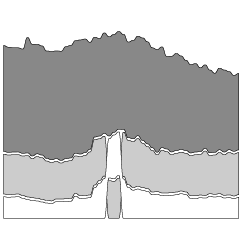
    The layers in the series of stacked area charts are mostly minding their own business pre-inauguration, and then suddenly they are not.

  • The U.S. is buying a lot less from China this year, but China has found more business just about everywhere else in the world. For the New York Times, Agnes Chang and Daisuke Wakabayashi have the charts.

    China has offset the decline from America with breathtaking speed. Shipments to other parts of the world have surged this year, demonstrating that China’s manufacturing dominance will not be easily slowed. Chinese exports are on track to reach another record this year.

    That’s because China was prepared. It has been seeking out new customers for years, and its massive manufacturing investment allows it to sell goods at low prices.

  • Members Only

    This week is about highlighting differences and visualizing characteristics over the data itself.

  • The administration aims to make it harder to claim disability insurance. Eli Hager, reporting for ProPublica, describes why that will hit states differently.

    These changes would fall disproportionately on some of Trump’s most loyal supporters in red states. Most affected would be 50- to 60-year-olds without a high school or college education who have, for decades, toiled in physically grueling jobs, including coal mining, logging, and factory and construction work. The five states where the highest proportions of people rely on these benefits are West Virginia, Arkansas, Kentucky, Mississippi and Alabama. Unlike New York, California and a few others, these states do not have their own disability insurance programs for workers to turn to amid federal cuts.

  • In May, NOAA’s disaster database was canceled because it is related to climate. Climate Central has resurrected the project. Sophie Hurwitz for Grist reports:

    Last week, Climate Central resurrected one of the most prominent of those lost records: the National Oceanic and Atmospheric Administration’s billion-dollar disaster database. The tool allowed policymakers, insurers, and regular people to track how hurricanes, floods, and other catastrophes are growing more expensive — until the agency said in May that it would no longer update the database “in alignment with evolving priorities, statutory mandates, and staffing changes.” The move was part of the administration’s broader effort to roll back climate action and push more of the cost of disaster monitoring and response on to states.

    Access the database here. I hope more organizations can follow suit.

  • Women and men tend to spend their days differently in the United States. Varying responsibilities and priorities will do that.

  • Peter Oppenheimer, the chief global equity strategist for Goldman Sachs, points to the ratio of stock price to earnings (P/E ratio) of current major tech stocks compared against the ratios of stocks during past bubble bursts. Financial Times uses a variable width bar chart to show the difference.

    Besides the meme-ish Tesla stock, the rest (of the Magnificent 7) seem low in comparison. If you’re looking for a sign that there’s more room for the bubble to grow, this would be it.

    On the other hand, we talk in trillions of dollars now for these giant corporations while other areas of the economy seem less great. So use that information as you like.