It's funny how data is finding it's way into everyday objects. There was jewelry a few months ago and coins last month. Now we've got this experiment with Christmas ornaments from Really Interesting Group (RIG). The snowman's head is sized by the number of followers on Twitter; the (rain) bars represent miles traveled per month on Dopplr; the red shows listening habits on last.fm; and finally, the blue one shows apertures you've used over the year for photos uploaded to Flickr. Continue Reading
2010
-
Data Visualization Christmas Ornaments
-
Buy a Print. Support Distaster Relief in Haiti. Please.
Unless you live under a rock inside a cave in the remotest area in the world, you know a huge quake struck Haiti on Tuesday, and much lies in ruins. The New York Times just posted some before and after satellite images, and it's a horrible thing to see. Buildings gone. People gone.
It pains me to think about what if that were to happen to me or my family.
To this end, I'm donating all proceeds from World Progress Report orders, along with this month's FlowingData revenues, to UNICEF's relief efforts. The Report, after all, is an effort to relate to the rest of the world. It only seems fitting. It's not much in the grand scheme of things, I guess, but at least it's something. As they say, every little bit counts.
Again, I'm taking orders for one week - through January 21. Do some good and get something good too. I'm including How America Learns with all orders now. Buy a print now.
Or if the World Progress Report just isn't your thing, you can donate directly to UNICEF.
I mean, seriously, there are 27,000 of you + me. We can make a big difference together.
-
Graphical World Progress Report – Now Available
Want the report? Details at the end on how to get a print. (Update: All proceeds go to UNICEF towards relief effort in Haiti.
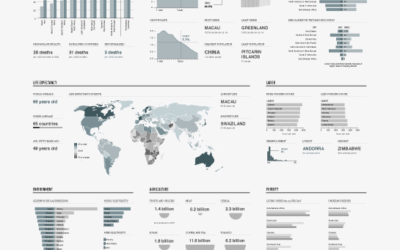
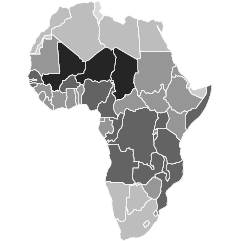
UNdata provides a catalog of 27 United Nations statistical databases and 60 million records about the past, present, and future state of the world. Topics include demographics, life expectancy, labor levels, poverty, and a lot more. What does all that data mean though? World Progress Report, the latest from FlowingPrints, offers a look into the expansive UN collection.
In whole, the report tells a story of how we live and die, and the stuff in between.
Continue Reading -
Timescapes to Compare Chopin Recordings
How do you compare music visually? You can break it down into data by quantifying the notes, volume, etc and then visualize it with timescapes (above). The horizontal axis represents musical time, from the beginning to end of a piece. Large blocks show similarities to other pieces and smaller noisy chunks show more "fleeting" similarities.
Continue Reading -
Data Underload #4 – Little Things
-
The Geography of Netflix Rentals
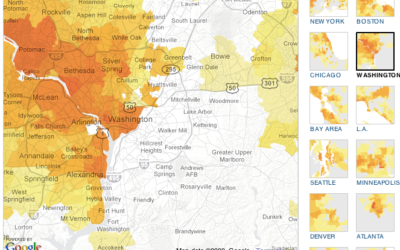
Some movies are popular everywhere. Others are popular only in certain regions. The New York Times, in a nice team effort, maps rental popularity by zip code for large regions in the US.
Continue Reading -
Need to Escape Jupiter’s Gravitational Pull? Good Luck
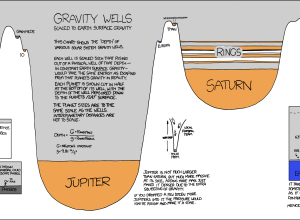
Randall of xkcd has been having fun with data visualization lately. In his latest data-ish comic, Randall explores gravity wells. The height of each well is sized relative to the amount of energy (on Earth) it would take to escape that planet's gravity. The width of wells are scaled by planet size.
So you'd need one big arse rocket to escape Jupiter.
I know it's a comic, hand-drawn, and all stick-figurey and stuff, but Randall actually explains the concepts really well. There's good annotation, clear examples, and he's made an obscure topic easy to understand.
It's also entertaining in the Bill Nye the Science Guy (i.e. best Saturday morning show ever) sort of way.
[Thanks, Ricki and Thomas]
-
Graphical World Progress Report – A Sneak Peek
FYI: A new edition on the current state of the world is coming soon from FlowingPrints. Join the mailing list to be first to know when it's available. I'm only going to take orders for one week this time around, so please please make sure you sign up. More info coming next week.
Continue Reading -
11 Ways to Visualize Changes Over Time – A Guide
Deal with data? No doubt you've come across the time-based variety. The visualization you use to explore and display that data changes depending on what you're after and data types. Maybe you're looking for increases and decreases, or maybe seasonal patterns.
This is a guide to help you figure out what type of visualization to use to see that stuff.
Continue Reading -
Even Older Infographics from the 19th Century
Old graphics are awesome. We saw some from the 1930s already. These are even older.
Other than the maps, I don't exactly know what I'm looking at (knowing French would help too), but who cares? Mmm, hand-drawn goodness.
Continue Reading -
A Visual History of Loudness in Popular Music
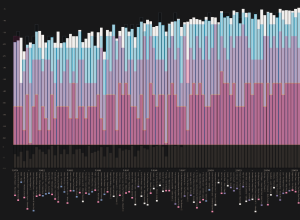
All Things Considered discusses why music sounds worse than it did a few decades ago. Through a practice using compressors, the quiet parts of a song are made louder and the louder parts quieter so that the song as a whole sounds louder to your ear. The purpose: to make the song stand out when you hear it on the radio.
As a result, tracks have gotten louder over the years.
Continue Reading -
Data Underload #3 – The Resolution Cycle
-
The Universe as We Know It
The Known Universe from the American Museum of Natural History shows a view of the universe, starting from the Himalayas and quickly moving out to the edge where all is black and scary - made possible by the records in the Digital Universe Atlas.
Continue Reading
How recruiters look at your resume
Data and visualization blogs worth following
Bed cartography
Metal bands per capita
Under the Sea, Under the Sea
Pancake Venn
Interactive Islands of Mankind
Visualize This