-
Members Only
-
For the New York Times, Ruth Igielnik and Katherine Chui charted presidential approval ratings against gas prices in the United States. The two metrics used to correlate strongly, but it’s grown more noisy over the past decade. That might change back:
Polarization, he said, plays a large role in that change.
“Presidents have fairly unified support from their own party, and unified opposition from the other party, which means they have a higher floor and a lower ceiling,” he said, referring to approval ratings.
Still, the current gas spike could be different. The quick pace with which prices have jumped may be enough to upend that trend.
Gas prices in the U.S. have increased to over $4 per gallon. Here in California, some gas stations are charging over $7 per gallon. Maybe we’ll find out if there’s a threshold for gas prices that lowers the approval floor.
-
Artemis II launches today, scheduled for 6:24 pm EDT. Die Zeit mapped the journey to the moon and back (paywalled). Illustrated to scale and focused on the spacecraft while scrolling, it feels like the opening to space documentary. It just needs a soundtrack and an even-keeled astronaut to narrate the wonders of the universe.
-
Researchers at Stanford University, epidemiologists Mathew Kiang and Nathan Lo, estimated the number of people who would die or be disabled if vaccines were no longer available in the United States. They did this for four diseases: polio, measles, rubella, and diphtheria. ProPublica illustrated the scale of these estimates, if Robert F. Kennedy Jr. got his way.
Not ideal.
-
For Bloomberg, Loren Grush, Sana Pashankar, and Stephanie Davidson describe the Artemis II plan for the evening of April 1.
The mission is a critical milestone in NASA’s ambitious Artemis campaign, aimed at landing humans on the moon once again. In Greek mythology, the goddess Artemis is the twin of Apollo – a nod to the predecessor program that put US astronauts on the lunar surface. This time, however, NASA hopes to establish a base there, where humans can live and work.
The rocket was illustrated with Blender and flight paths are shown with Three.js. I always appreciate a bit of 3-D flourish in space-related illustrations.
-
Four astronauts are rocketing to the moon on April 1. They’ll spend 10 days orbiting Earth a few times, head out to the moon, circle around, and then come back. Marco Hernandez and Kenneth Chang, for the New York Times, have the illustrations showing the rocket specifications, flight path, and the crew module with the space of two whole minivans.
-
A so-called shadow fleet of tankers transport oil illicitly around the world. They had been on the decline, but the conflict in Iran has changed things. Financial Times mapped the paths and tactics used by these old ships to avoid detection.
These views from above make me think it won’t be long until ship tracking and detection systems are all just based on satellite images. That’s gotta be a thing by now.
-
The world’s reliance on gas and oil means the war in Iran affects people everywhere, and you can feel it in the everyday. Pablo Robles and Agnes Chang, for the New York Times, point out the many facets of life that had to adjust.
The small animated illustrations make this piece. They show a bit of what everyone is experiencing these days: pain at the pump and a balloon, a simple joy floating away out of reach.
-
A large portion of rural hospitals operate at a loss, which causes problems for millions of Americans who need healthcare the most. For Reuters, Sarah Slobin shows the challenging dynamics of rural hospitals with a series of charts and maps.
Nearly 90% of the land in the United States is rural and about one in five people, or some 60 million, live throughout it according to the U.S. Census. Data also show rural residents are older, have worse health outcomes and less health care access than their urban counterparts.
-
It seems like people don’t stick with the same job for as long as they used to, but maybe that’s not the case.
-
Members Only
-
For the New York Times, Lazaro Gamio, Blacki Migliozzi, and River Akira Davis use a Sankey diagram to show the breakdown of oil and gas that flows through the Strait of Hormuz.
The layout for the story works well. It starts with the origin countries, sized by the percentage of energy through the strait. A pause in the middle at the strait shows the full amount, which then splits into where the oil exports to. Red text notes disruptions.
-
Getting pregnant and having a child is typically described as an effortless process where you try and then you succeed. However, the process is often not so direct. For the Pudding, Lam Thuy Vo, with help from Jan Diehm and Michelle Pera-McGhee, and illustrations by Rose Wong, describes the journey of infertility and IVF.
You are able to move through from the point of view of parent or child. Switch back and forth or go all the way with each separately.
-
Lazaro Gamio and Josh Holder for the New York Times break down energy imports by country and the percentage that comes from the Middle East.
It seems likely that these percentages will swing one way or another in the near future, but variable width bar charts are my statistical chart weakness. Total energy, in dollars, is on the y-axis, and the share of that from the Middle East, by percentage, is on the x-axis. There are a set of four charts for Asia, Europe, Africa, and the Americas, with consistent scales across the set.
-
Unmanned and relatively cheap drones that can be manufactured in high volume have changed airspace typically dominated by expensive jets and trained pilots. Reuters illustrates the shift that allowed less equipped countries to fight against larger ones.
In just the first week of the conflict, Iran launched more than 1,000 drones and it is estimated to have the capacity to produce around 10,000 per month.
The technology of war has evolved rapidly in recent years, a shift starkly illustrated by Ukraine’s fight against Russia. What began as a conflict dominated by tanks and artillery has increasingly become a drone war. Outgunned in conventional armor and aircraft, Ukraine turned to inexpensive unmanned systems for reconnaissance and attack. Drones are estimated to account for about 70% of Russian casualties, enabling strikes to be carried out remotely and reducing the risk to pilots and aircrews.
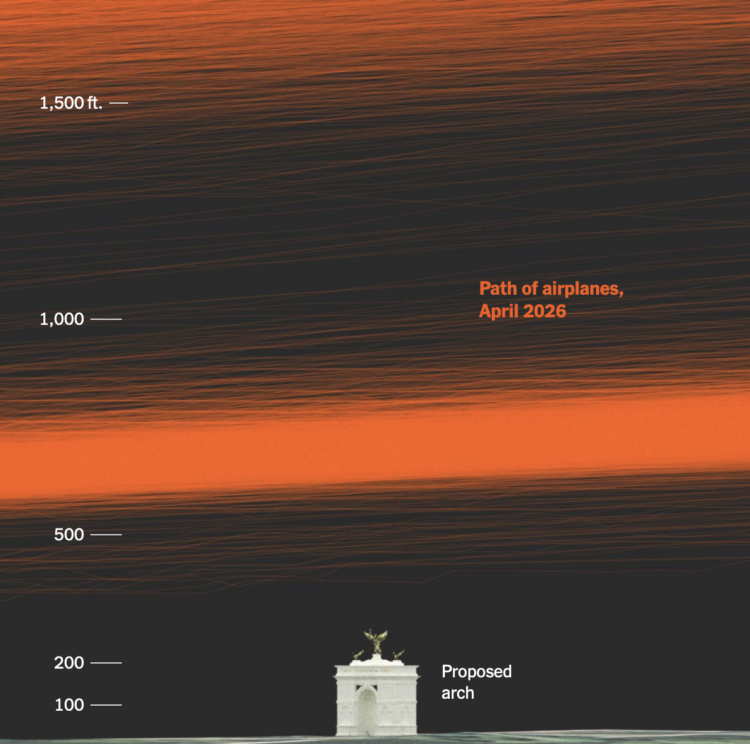
The build-up to show scale in this piece is quite something. Expensive and specialized aircraft fly across at first. Then a switch to hundreds of drones filling the sky shows the task of defending against high volume.
-
Along with more arrests, the current administration has deported mothers at twice the rate as the previous administration. ProPublica reports, using data obtained through a public records lawsuit by the University of Washington Center for Human Rights.
A Sankey diagram is used to show arrests by administration, the percentage detained, and of those, the percentage released, in custody, or removed or deported. This led to 11,000 children separated from their mothers by the current administration — and this is only as of August 2025, as UW continues the court process to get more data.
-
For the New York Times, Albert Sun, Allison McCann, and Hamed Aleaziz obtained data through an internal ICE document to see arrests over time.
Some places that did not have high-profile ICE operations this year, such as Florida and San Antonio, have still seen high and steadily increasing numbers of arrests. In other areas like Los Angeles and Chicago that were targeted by ICE with aggressive enforcement operations last year, the number of arrests has fallen steeply in recent months. And in some areas — notably many places with so-called sanctuary policies in place — the arrest rate is flat, or up only slightly.
-
For NYT’s the Upshot, Francesca Paris gives context to the recent spike in gas prices in the United States:
It’s the second-largest four-week increase in at least 30 years — bigger than the one at the start of the war in Ukraine in 2022, or the ones associated with the post-recession surge of 2009 and the OPEC production cuts in 1999.
The only bigger jump came after Hurricane Katrina in 2005, when gas supply fell significantly.
Rising everyday expenses probably don’t help the situation. For those keeping track, 50 Cent is currently adjusted to 111 Cent as of this writing.
-
From xkcd, a map sketch of why the landscape is what it is in the United States.
-
In most places, property lines stop at the street, but in North Oaks, Minnesota, property lines extend to the middle of the street. This makes the entire city private property, which prohibits Google and other mapping companies from driving through to take street-level photos. Chris Parr figured out how residents achieved this block (mostly money) and then found a way to map the area himself.
[via 404 Media]
Visualize This: The FlowingData Guide to Design, Visualization, and Statistics (2nd Edition)