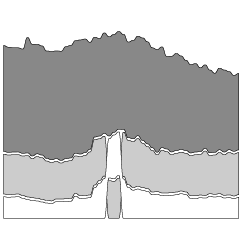
• ProPublica and the Texas Tribune report on the spike of claims over the past year, which make previous volumes seem almost like nothing:

    So far this year, immigrants are filing on average more than 200 of these cases, known as habeas petitions, daily across the country, with California and Texas accounting for about 40% of new cases, a ProPublica analysis of federal court filings found. To keep tabs on this historic rise, ProPublica is publishing a habeas case tracker.

  • Paul Ford, for NYT Opinion, on his outlook for making software by vibe coding:

    My industry is famous for saying no, or selling you something you don’t need. We have an earned reputation as a lot of really tiresome dudes. But I think if vibe coding gets a little bit better, a little more accessible and a little more reliable, people won’t have to wait on us. They can just watch some how-to videos and learn, and then they can have the power of these tools for themselves. I could teach you now to make a complex web app in a few weeks. In about six months you could do a lot of things that took me 20 years to learn. I’m writing all kinds of code I never could before — but you can too. If we can’t stop the freight train, we could at least hop on for a ride.

    The simple truth is that I am less valuable than I used to be. It stings to be made obsolete, but it’s fun to code on the train, too. And if this technology keeps improving, then all the people who tell me how hard it is to make a report, place an order, upgrade an app or update a record — they could get the software they deserve, too. That might be a good trade, long term.

    The trouble is that we don’t know where the train is headed. Some paint a hopeful picture of some kind of utopia, and others point towards a dystopia where a few benefit at the expense of everyone else. I have no idea. I remain cautiously pessimistic.

  • Over the decades, we can see the shifts (and non-shifts) in professional priorities and interests by looking at what college students are studying. The National Center for Education Statistics has kept a running tally of conferred bachelor’s degrees since 1970.

  • Members Only

    This week is about how we rank from best to worst and use visualization to highlight order.

  • For Reuters, Ally J. Levine and Tiana McGee illustrate and chart the rise:

    Then there’s the music itself. “You don’t have to understand every single historical reference in a song like ‘La Mudanza’ to want to dance to ‘La Mudanza’,” said Diaz. “Everyone’s getting something different, with or without the lyrics.”

    The data show Bad Bunny’s formula is working. He ranks consistently on Billboard’s list of top artists, and his albums remain popular years after release.

    Prior to the Super Bowl, many people were not familiar with the artist Bad Bunny or his music, which made many wonder why he was performing for the halftime show. At the same time, millions of other people listen to Bad Bunny’s music and he has been breaking streaming and awards records over the past few years.

    There are some fun charts in this piece. I like the one above that uses palm trees to represent popularity index and flowers to show Billboard ranking. The playful quality is more in tune to the subject.

  • With the most recent Epstein release, the Economist collaborated with the folks who work on Jmail to breakdown the many pages of email between Epstein and others.

    He did not waste time on middle managers. A quarter of his top non-staff contacts have a Wikipedia page. He traded emails with at least 18 current or former billionaires, including Peter Thiel and Elon Musk; celebrities like Woody Allen and Deepak Chopra; and political figures such as Ehud Barak, a former Israeli prime minister. Most back-and-forths were balanced, with similar numbers of emails sent and received; an exception was Bill Gates, whom Epstein bombarded despite few responses. (Mr Gates was happy to meet Epstein on a number of occasions, however.)

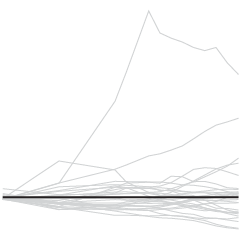
    Most of the email was with staff and business partners. To find the more troublesome threads, a large language model was used to score emails with an “alarm index.” Although the strip plot above focuses on volume over content.

  • Meta’s smart glasses have an outward facing camera pointed at what you’re looking at. This lets you record video and take photos. As they integrate AI deeper into the product, Meta plans to bring facial recognition with that camera. The New York Times viewed an internal memo on how Meta hopes to launch this feature.

    Meta’s internal memo said the political tumult in the United States was good timing for the feature’s release.

    “We will launch during a dynamic political environment where many civil society groups that we would expect to attack us would have their resources focused on other concerns,” according to the document from Meta’s Reality Labs, which works on hardware including smart glasses.

    It’s not surprising they were having such discussions. But still. They’re not exactly making it easy to trust them to do right with your data, information, and privacy.

  • The Amazon-owned security system Ring was planning to partner with Flock Safety, who supplies security footage and contracts with law enforcement. Ring has canceled the partnership.

    In October 2025, Ring and Flock Safety announced our intention to work together on an integration with Community Requests. Following a comprehensive review, we determined the planned Flock Safety integration would require significantly more time and resources than anticipated. As a result, we have made the joint decision to cancel the planned integration. The integration never launched, so no Ring customer videos were ever sent to Flock Safety.

    At Ring, our mission has always been to make neighborhoods safer. That mission comes with significant responsibility—to our customers, to the communities we serve, and to the trust you place in our products and features.

    If Flock sounds familiar, maybe you’re remembering them as the ones who send license plate information to immigration agents. That was in August 2025.

    This comes shortly after Ring’s Super Bowl commercial for dog-finding. Ring owners were already rumbling, but it seems cute dogs were not enough to calm things down. Trust is already lost.

  • xkcd drops the knowledge with a proper classification for the stapler. The pairwise matrix, a favorite xkcd mechanic, is used to show the groups.

  • During the Super Bowl, Ring ran a commercial that shows how everyone’s doorbell camera can be joined in a single system to find a lost dog. For 404 Media, Jason Koebler points out the privacy implications for when that system is used to find people.
    Read More

  • Members Only

    This week is about tracing back for context and comparing.

  • ProPublica updated their explorer for money flowing into 527s.

    Every year, hundreds of millions of dollars flow through political organizations known as 527s. These organizations are not regulated by the Federal Election Commission and are not subject to FEC-style restrictions on who can contribute or how much they can give, though donations are not tax deductible. These groups are spending more and more, topping $1 billion in 2022. Use our database to explore who funds these organizations and how they’re spending the money.

  • In the women’s downhill, Breezy Johnson won gold with a time of 1 minute and 36 seconds, plus 10 hundredths of a second. Emma Aicher of Germany won silver with a time of 1 minute and 36 seconds, plus 14 hundredths of a second. The New York Times used compositing to show how close the race was, as if Johnson and Aicher were skiing at the same time.

    That is nuts. You do the best with what you have and the rest is decided by randomness on the mountain.

  • Science analyzed employment data from the Office of Personnel Management to calculate the loss of STEM PhD employees in the federal government. Over the past year, the cohort shrank by 10,109, which was 14% of government PhDs. Most who left either quit or retired.

  • Theo Sanderson visualized the network of 3.4 million Bluesky users, placed by follow patterns. It is searchable and interactive. If you zoom in close enough, you can find our tiny pocket of data visualization folks, cluster adjacent to the R community, cartographers, and Brazilian software developers.

    Sanderson described some of the process on Bluesky.

  • Olympic figure skater Ilia Malinin earned the nickname “Quad God” for all his completed quadruple jumps in competition. The New York Times recorded his most difficult quadruple axel with a high-speed camera, breaking down the challenge of spinning four times in the air.

    In the past, when a jump had been conquered, it often did not take long for other skaters to master it too. Not so for the quad axel. Aside from Malinin’s successes, it has only been tried in competition by two other skaters. Artur Dmitriev Jr. was the first to attempt the jump in competition, in 2018, but he fell. Japan’s Yuzuru Hanyu attempted the jump at the 2022 Beijing Olympics before retiring, but he did not land it either. It has been more than three years since Malinin’s first quad axel, and no one appears poised to match him.

  • Aruna Ranganathan and Xingqi Maggie Ye are studying how work loads are shifting as companies try to integrate AI into the flow. So far it seems that AI is mostly creating a different kind of work and more of it. On Harvard Business Review:

    AI introduced a new rhythm in which workers managed several active threads at once: manually writing code while AI generated an alternative version, running multiple agents in parallel, or reviving long-deferred tasks because AI could “handle them” in the background. They did this, in part, because they felt they had a “partner” that could help them move through their workload.

    While this sense of having a “partner” enabled a feeling of momentum, the reality was a continual switching of attention, frequent checking of AI outputs, and a growing number of open tasks. This created cognitive load and a sense of always juggling, even as the work felt productive.

    Over time, this rhythm raised expectations for speed—not necessarily through explicit demands, but through what became visible and normalized in everyday work. Many workers noted that they were doing more at once—and feeling more pressure—than before they used AI, even though the time savings from automation had ostensibly been meant to reduce such pressure.

    I don’t think I like this direction. I was really hoping we’d go the other way where all current work is done with AI tools but companies still pay employees the same amount.

  • While it’s easy to go out for a run in most places, finding the nearest mountain (that still has snow on it) or speed skating track is less straightforward. So Emily Giambalvo, Dylan Moriarty, and Kati Perry, for the Washington Post, show the winter sports facilities near you. There is a map and a list of the sports within an hour drive.

    Now you too can train to be an Olympic ice skater. Distance was the only thing holding me back. No longer.

  • For Bloomberg, Shawn Donnan runs the numbers and discusses how this might affect economic growth.

    In the year prior to July 1, 2025, the US Census revealed this week that the population grew by only 0.5%, or 1.8 million people, its lowest growth since the pandemic. The main cause for the significant slowdown was a collapse in net migration to 1.3 million from a peak of 2.7 million in the year prior to July 2024.

    In that most recent period, there were 519,000 more births than deaths, according to the new Census figures. That surplus is shrinking, however. By 2030 it’s likely to disappear altogether, making the US entirely dependent on immigration for population growth, according to the nonpartisan Congressional Budget Office.

    If net migration (arrivals minus departures) is negative, and large enough to outweigh that births-minus-deaths figure, then the US population shrinks. And there’s little question that net migration is getting smaller thanks to Trump’s policies. Census experts this week said they expect it to fall to only 316,000 in the year prior to July 2026, with the US “trending toward negative net migration.”

    No one wants to (or is able to) come to the United States. Births and deaths approach even. Population flatlines or declines. I feel like there’s some movie that starts out like this and doesn’t end well.

  • Olympic gold medalist Ted Ligety is on the New York Times to explain why: there are many variables that athletes cannot control while skiing really fast down a mountain in the winter.

    One of my favorite parts about the Olympics is the information graphics. There haven’t been as many over the years, so it’s good to see this short-form piece with a mix of video and illustrations.