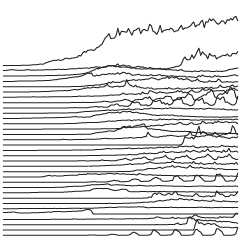
• For NYT’s the Upshot, Francesca Paris gives context to the recent spike in gas prices in the United States:

    It’s the second-largest four-week increase in at least 30 years — bigger than the one at the start of the war in Ukraine in 2022, or the ones associated with the post-recession surge of 2009 and the OPEC production cuts in 1999.

    The only bigger jump came after Hurricane Katrina in 2005, when gas supply fell significantly.

    Rising everyday expenses probably don’t help the situation. For those keeping track, 50 Cent is currently adjusted to 111 Cent as of this writing.

  • From xkcd, a map sketch of why the landscape is what it is in the United States.

  • In most places, property lines stop at the street, but in North Oaks, Minnesota, property lines extend to the middle of the street. This makes the entire city private property, which prohibits Google and other mapping companies from driving through to take street-level photos. Chris Parr figured out how residents achieved this block (mostly money) and then found a way to map the area himself.

    [via 404 Media]

  • Emanuel Fabian, a military correspondent for the Times of Israel, received death threats from Polymarket gamblers after he reported a missile strike in Israel.

    “You have no idea how much you’ve put yourself at risk. Today is the most significant day of your career. You have two choices: either believe that we have the capabilities, and after you make us lose $900,000 we will invest no less than that to finish you. Or end this with money in your pocket, and also earn back the life you had until now.”

    After I didn’t respond, as I was asleep, Haim sent me another series of messages: “You are choosing to go to war knowing that you will lose your life as you’ve grown accustomed to it — for nothing.”

    On Sunday morning, he messaged me again: “You have exactly a few hours left to fix your attempt at influencing [the market]. It would be stupid of you to ignore this.”

    It seems the wisdom of crowds also goes the other direction.

  • Members Only

    This week we have conflicting views and a search for honesty in charts.

  • John Rush has been scanning his receipts for 25 years. He did something with the collection this year.

    Everyone needs a rewarding hobby. I’ve been scanning all of my receipts since 2001. I never typed in a single price – just kept the images. I figured someday the technology to read them would catch up, and the data would be interesting.

    This year I tested it. Two AI coding agents, 11,345 receipts. I started with eggs. If you can track one item across 25 years of garbled thermal prints, OCR failures, and folder typos, you can track anything.

    This made me think about those science fiction stories with people who freeze themselves hoping to wake in an era when cures to their terminal disease become available. It’s the sales receipt data version. Twenty-five years is a long time to collect data.

    [Thanks, Charlotte]

  • Researchers at GovAI and Brookings estimated vulnerability to job displacement due to AI. For the Washington Post, Kevin Schaul and Shira Ovide charted the estimates on two dimensions: exposure and adaptability.

    Estimating vulnerability is difficult, because a single factor like exposure isn’t enough. A job might have high exposure to AI tools, but that doesn’t always mean the job is at risk. You might just have new responsibilities and use the tools more.

    I don’t think firefighting is in the cards for me. Maybe I’ll get into manicures. Although “other mathematical science occupations” has lowest vulnerability and high adaptability so maybe I have a few years left.

  • Julia Angwin is suing Grammarly. For NYT Opinion, Angwin explains the reasons and why we need better laws to protect ourselves from AI companies.

    In this global crisis of consent, we must make use of the few anchors we have for enforcement. The right of publicity is one of them, but it needs to be strengthened into a federal law — not just a patchwork of state laws. In some states, it applies only to advertising; in others, to all types of commercial uses. In some, it covers only celebrities; in others, it applies to everyone.

    Thus far, the proposed updates to the law have been too narrow. The No Fakes Act, introduced last year by a group of senators, including Minnesota’s Amy Klobuchar, would prohibit “A.I.-generated digital replicas” of people without their consent, but would not cover the use of people’s names in text-based services like Grammarly. The Student Athlete Fairness and Enforcement (SAFE) Act, proposed by several senators, including Washington’s Maria Cantwell, would prohibit the use of people’s names without their consent — but only for student athletes.

    And a new term coined by Ingrid Burrington came to light: sloppelgänger.

  • For the New York Times, Ben Casselman reports on a previously undisclosed change in data source by the Bureau of Economic Analysis, which led to an inflation estimate that was lower than expected.

    Data on legal services usually comes from the consumer index. But the Bureau of Labor Statistics, which has struggled with budget cuts and staff attrition, hasn’t been able to collect enough data in recent years to publish the legal services index consistently. It has continued to provide the data to the Bureau of Economic Analysis, but the monthly readings have been volatile.

    In January, the C.P.I. for legal services jumped more than 11 percent, according to analyses of data from the Bureau of Labor Statistics conducted by private-sector forecasters.

    As a result, the Bureau of Economic Analysis decided to base its estimate of legal prices in January on the producer price data, which has been less volatile. Mr. Davis said that the jump in legal services prices in the C.P.I. data — and the absence of a clear reason for such a big increase — made that the right decision.

    The challenge with comparing data over time is that methodology needs to stay the same or at least get a footnote so that analysts can adjust. The BEA responded that this was not a methodology change and just a substitute for volatile data, which seems convenient given the current state of government data.

  • xkcd continues to answer the important questions.

  • Iran is starting to deploy mines in the Strait of Hormuz. For the New York Times, Samuel Granados, John Ismay, and Agnes Chang illustrate how four types of naval mines work to damage tankers.

    The geography of the strait and the surrounding waters works to Iran’s advantage. A long southern coastline affords ample opportunity for small boats to dart out with mines.

    Tight shipping lanes leave little room to navigate. And the water at the strait’s narrowest point is only about 200 feet deep — shallow enough to lay minefields.

    As one might expect, clearing mines with potential attacks from above is not as straightforward as clicking on a Minesweeper game grid.

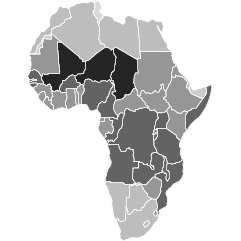
  • You’re probably familiar with the song “Africa” by Toto. This version, by There I Ruined It, uses all the country names in Africa instead of the actual lyrics. There’s a useful geography lesson somewhere in here.

  • There was a total lunar eclipse on March 3, 2026. From Michala Garrison mapping for NASA Earth Observatory, shows the shades before, after, and during.

    When the satellite passed over western Alaska and the Bering Strait, at 13:00 Universal Time (4:00 a.m. Alaska Standard Time), the eclipse was in the partial phase. The scene is noticeably brighter than the earlier one, and light from the partially shaded Moon illuminates snow-covered topography and offshore clouds. The brightest swaths on the far right and left sides were acquired before and after the eclipse, respectively, with light from the full Moon.

  • Members Only

    This week is about fake charts and keeping ourselves in the feedback loop.

  • After backlash over their tool that pretends to provide expert editing advice, Grammarly shut down the AI feature. Now they face a class action lawsuit. Miles Klee reports for Wired:

    Julia Angwin, an award-winning investigative journalist who founded The Markup, a nonprofit news organization that covers the impact of technology on society, is the only named plaintiff in the suit, which does not call for a specific amount in damages but argues that damages across the plaintiff class are in excess of $5 million. She was among the many individuals, alongside Stephen King and Neil deGrasse Tyson, offered up via Grammarly’s “Expert Review” tool as a kind of virtual editor for users.

    The federal suit, filed Wednesday afternoon in the Southern District of New York, states that Angwin, on behalf of herself and others similarly situated, “challenges Grammarly’s misappropriation of the names and identities of hundreds of journalists, authors, writers, and editors to earn profits for Grammarly and its owner, Superhuman.”

  • Upon finding out that Grammarly uses AI-generated editing, supposedly driven by real authors, Casey Newton for Platformer kicked the tires on the fakery.

    And there, hovering near the top of the draft, was John Carreyrou, the investigative journalist and bestselling author who took down Theranos. I’d pay good money for advice from the real Carreyrou, whose dogged pursuit of the truth behind Elizabeth Holmes’ company in the face of overwhelming legal threats is the stuff of legend. Alas, the fake Carreyrou conjured by Grammarly offered only the most anodyne of advice.

    As Newton points out, plenty (or all) LLMs are driven by data that was slurped up from any available resource. So any generated writing is based on someone else’s, but Grammarly took the extra step of putting real author and writer names against the generated output without asking.

    Update Grammarly is now facing a class action lawsuit and shutdown the feature.

  • School children were killed in the poorly informed attack. The New York Times reports on the unconscionable mistake:

    The Feb. 28 strike on the Shajarah Tayyebeh elementary school building was the result of a targeting mistake by the U.S. military, which was conducting strikes on an adjacent Iranian base of which the school building was formerly a part, the preliminary investigation found. Officers at U.S. Central Command created the target coordinates for the strike using outdated data provided by the Defense Intelligence Agency, people briefed on the investigation said.

  • Shri Khalpada, as a technologist and musician, thinks through his mixed feelings for AI-generated music.

    A tool that jumps straight to the output short-circuits all of that. The output arrives before any discovery can happen. This treats creativity as a productivity or “content creation” problem, where getting to the output as easily as possible is the goal.

    There are of course parts of the music making process that are tedious and frustrating. An experienced producer sketching out an arrangement quickly or using AI to test a melodic idea before committing to it would be helpful. These cases straddle the line between a tool that helps us make music and a tool that generates it for us. I think these use cases can be much more straightforwardly helpful.

    The essay includes samples of AI-generated music against human-made music, and like writing passages, it is difficult to pick which is generated.

    However, as Khalpada argues, making music is more than a factory churning out songs to fill space in elevators.

    My kids take piano lessons and they often have to struggle through new songs before they get it right. Sometimes the songs are more difficult than usual, so when they finally get it, the joy and sense of accomplishment is multiplied. The thought of replacing that with a magic machine that spits out music with zero traction just seems wrong.

  • We are approaching a point (or we’re here already) where generated output is not much different from human-made things. So instead of deciphering what is fake and real, we might be asking which is better. For the New York Times, Kevin Roose and Stuart A. Thompson have a quiz that asks which writing passage reads better to you.

    These are isolated, short passages that don’t require sustained coherence, so it’s hard to tell the difference in the examples. Longer passages or articles would probably favor human writers, for now. I am curious if a decade from now, in search of human life, we seek craggly imperfections as a signal for a real brain and beating heart.

  • Pokemon is in its 30th year of existence. The Straits Times visualized the origins of each character in network form:

    In this tree of life, The Straits Times examines each Pokemon character’s closest proxies in the real world, uncovering the scientific concepts hidden in their designs. Beyond the original species, we delve into creatures from different dimensions and eras that were introduced in later versions of the game.

    They also tell the history of the game, links to real-world science, and its worldwide popularity.

    I know next to nothing about Pokemon, so this piece helped me better appreciate what the kids are talking about. It turns out there’s a bit more to it than just catching them all.