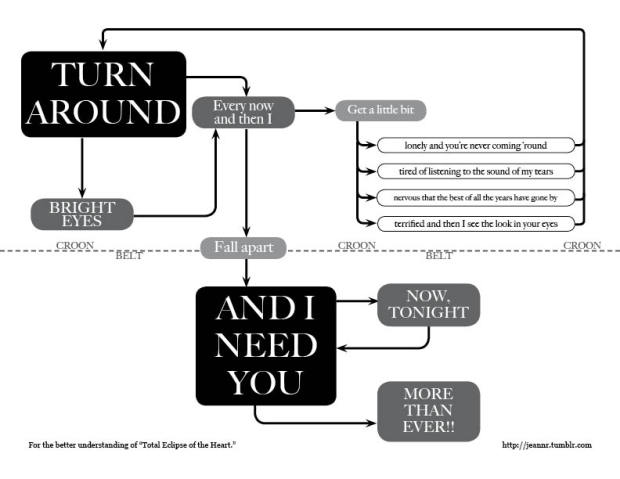
Jeannie Harrell takes Total Eclipse of the Heart by Bonnie Tyler, and puts it in flowchart form. Yes, you guessed it. It’s Friday. And what better way to start the weekend with the music video in all its 1980s glory.
Read More
Jeannie Harrell takes Total Eclipse of the Heart by Bonnie Tyler, and puts it in flowchart form. Yes, you guessed it. It’s Friday. And what better way to start the weekend with the music video in all its 1980s glory.
Read More
 It’s been fun to see your.flowingdata evolve the past few weeks, and it’s good to see so many of you making use of it. Thanks for all the useful feedback too.
For those already using YFD, you’ll be pleased to know there are a few new features. If you haven’t had the chance, you can start collecting data with YFD in just a few steps.
Read More
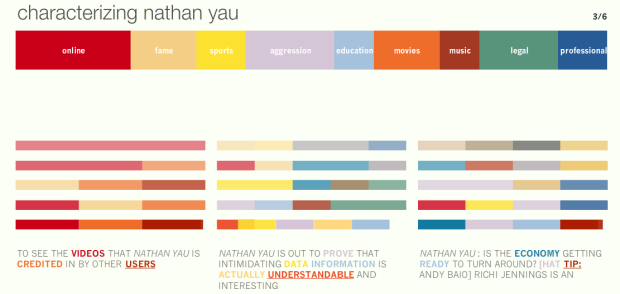
I Google myself every now and then. Everyone does. I don’t know why people act like it’s all weird to do it. We’re all interested in what’s out there on the Internet about us or someone with the same name as us. Some of it is right. A lot of it is wrong. Personas, from MIT’s Metropath(ologies) exhibit, scours the Web and attempts to characterize how the Internet sees you.
In a world where fortunes are sought through data-mining vast information repositories, the computer is our indispensable but far from infallible assistant. Personas demonstrates the computer’s uncanny insights and its inadvertent errors, such as the mischaracterizations caused by the inability to separate data from multiple owners of the same name. It is meant for the viewer to reflect on our current and future world, where digital histories are as important if not more important than oral histories, and computational methods of condensing our digital traces are opaque and socially ignorant.
The piece is about the incorrectness of your Internet profile just as much as what’s right.
As many have pointed out, the end result is kind of anti-climatic, but it’s fun to watch the process at work, which makes heavy use of natural language processing algorithm latent Dirichlet allocation [pdf] from Blei, et. al.
How does the Internet see you?
[via infosthetics | Thanks, Alexandria]
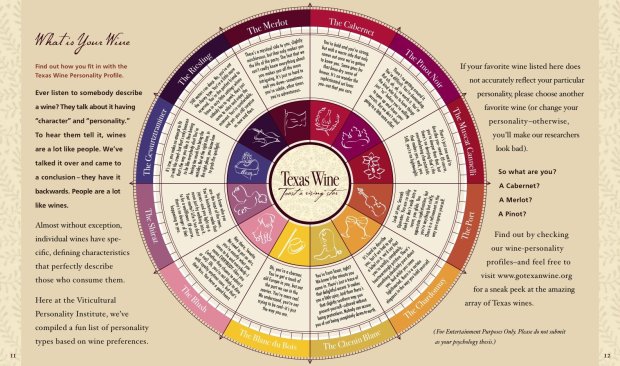
The Texas in a Bottle guide to Texas Wine [pdf] reads:
Ever listen to somebody describe a wine? They talk about it having “character” and “personality.” To hear them tell it, wines are a lot like people. We’ve talked it over and came to a conclusion – they have it backwards. People are a lot like wines.
And to that end, Go Texan Wine goes on to describe your personality based on what type of wine you prefer. Do you like Merlot? There’s a mystical side to you, slightly mischievous, but that only makes you the life of the party.
I’m difficult. I’m demanding. But oh, oh, oh, I am so worth it. What’s your wine personality?
[via Cool Infographics]
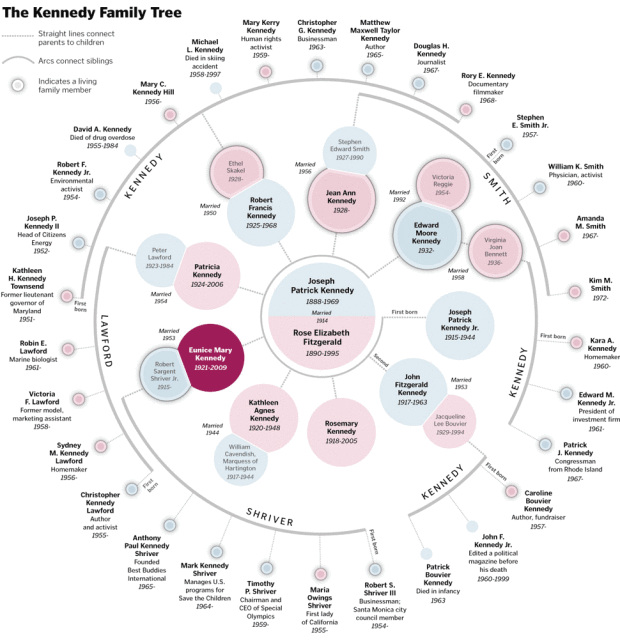
As far back as I can remember there’s always been a mystique around the Kennedy family. It’s almost like if you bear the Kennedy name, you’re destined for greatness. With the recent passing of Eunice Kennedy Shriver, Patterson Clark of The Washington Post maps out the famous family tree. The tree starts with the marriage of Joseph Patrick Kennedy and Rose Elizabeth Fitzgerald and branches out to current family members and what they do for a living.
[via DataViz]
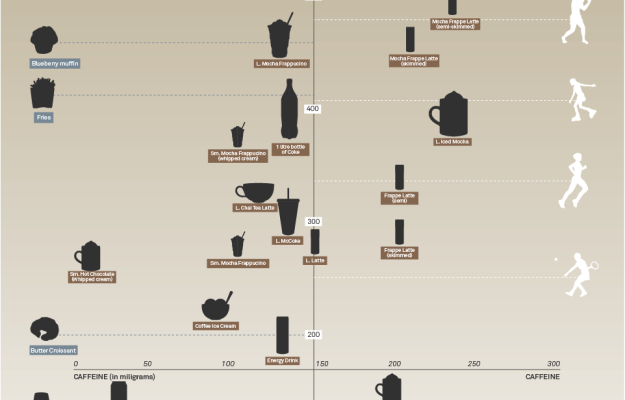
David McCandless from Information is Beautiful plots the calories in popular beverages versus the amount of caffeine in them. At the bottom right of the plot are drinks low in calories and high in caffeine. At the opposite end, top left, are beverages of high calories and low in caffeine. Food items (on the left) and physical activity (on the right) provide context to the calories.
[Thanks, Peter]
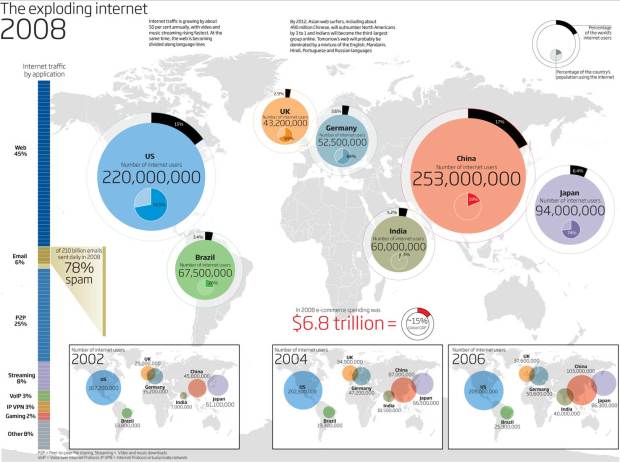
I, uh, well. Hmm. Yeah. New Scientist recently compiled a list of visualizations exploring the growth of the Internet. Here they are in no particular order (plus the one above).
Read More
Map/Territory, by designer Timo Arnall, is a concept video of what it might be like to interact with a map embedded in real life – not just on a phone or on a computer screen. Imagine a world where a flick of the wrist draws up all the information you need in real time and space. Check out the 30-second clip below:
[arve url=”https://vimeo.com/5572328″ /]
I really love stuff like this. Stuff like Map/Territory, Bruce Branit’s holographic world, Microsoft’s vision for 2019, or even the Starship Enterprise is simply beautiful. It’s fun to imagine what the future might be like.
Nevermind the how part. Technically speaking, I have no idea how Map/Territory would ever come to fruition, and I’m pretty sure Timo doesn’t either, but who cares? While technical know-how is absolutely useful and completely necessary, sometimes you need imagination and creativity to push the boundaries of what’s possible.
[via O’Reilly Radar]
As many of you know I’m just one graduate student maintaining FlowingData. Needless to say I would not have been able to handle the financial load without the FlowingData sponsors. Projects like your.flowingdata and FlowingPrints (coming soon) probably wouldn’t be around either.
So thank you, sponsors for your support. Please do check out their offerings. They all aim to make data useful, which is what FlowingData is all about.
InstantAtlas — Enables information analysts to create interactive maps to improve data visualization and enhance communication.
NetCharts — Build business dashboards that turn data into actionable information with dynamic charts and graphs.
Tableau Software — Data exploration and visual analytics for understanding databases and spreadsheets that makes data analysis easy and fun.
IDV Solutions — Create interactive, map-based, enterprise mashups in SharePoint.
Freakalytics — Get Tableau Training- live, hands-on by author of “Rapid Graphs.” Registration is opening up across the country.
Want to sponsor FlowingData, your most favorite blog in the whole wide world? Email me, and I’ll get back to you with the details.

Greater Greater Washington maps rider flow for the DC Metro. As you might guess, the thicker the path, the greater the estimated number of riders in that given area.
As the author notes, the data collection process was an unscientific one, so it should be taken with a few grains of salt, but this makes me wonder. These types of subway maps seem to be getting fairly common, in both the static and interactive/animated variety – but the visualization always seems to come from estimates.
Have any metro systems released their full data? I am sure there are tons of data logs sitting somewhere, growing every time someone swipes their metro card or drops in a subway coin. And more importantly, are metro systems using these types of visualizations to figure out how to distribute trains at different times per day? Do they use something better?
[Thanks, Jamie]

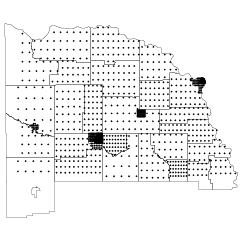
The U.S. Census Bureau doesn’t ask questions about religion because of political issues involving separation of church and state, so we don’t always get a very detailed view of religion. The Glenmary Research Center does collect this data, however.
The Valparaiso geography department maps this detailed data, and the extensive collection of choropleth maps can be found here.
Read More
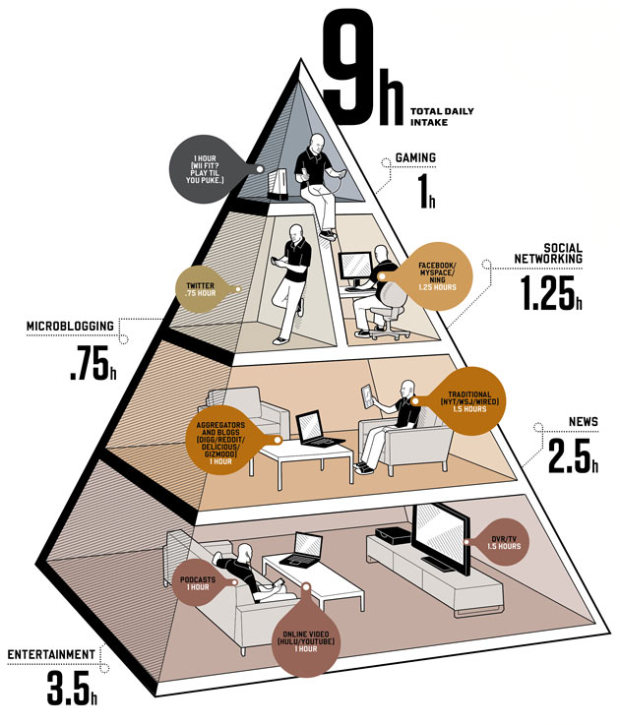
In the August issue of Wired are the New Rules for Highly Evolved Humans. On the cover is a picture of Brad Pitt wearing a bluetooth headset. Rule number 52 reads: “Ditch the headset. He can barely pull it off – and you’re not him.” Clearly these are confusing times, but you’re in luck, because Wired has mapped out how you should properly deal with this new way of living. Stick to the new rules and the media diet above (by Jason Lee) and you’re good as gold.
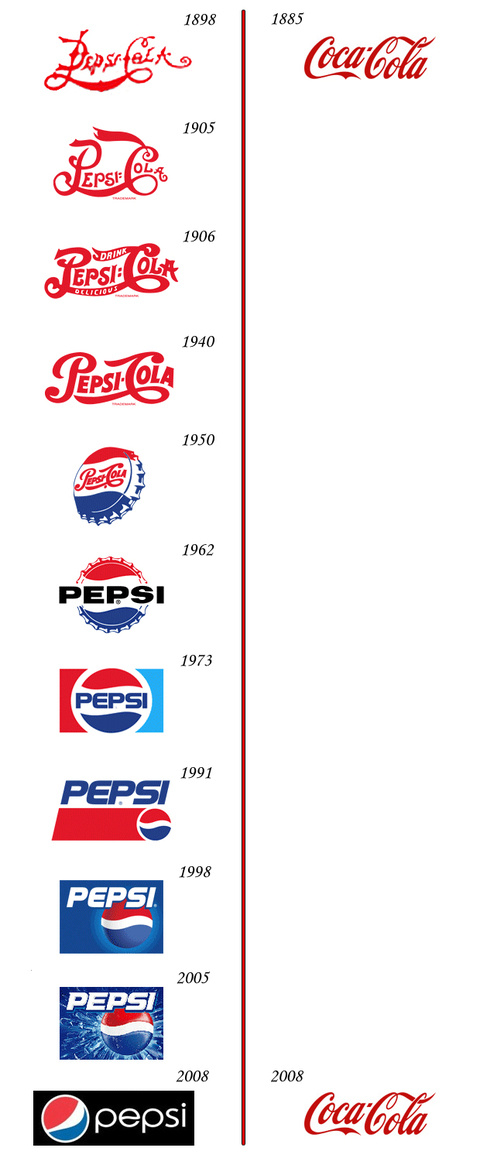
There have actually been some subtle changes in the Coca-Cola logo but not nearly as dramatic as the Pepsi logos. I personally think the new Pepsi design is atrocious. They should have stopped in 1973.
[via clusterflock & Daily Dish & Consumerist]
Read More
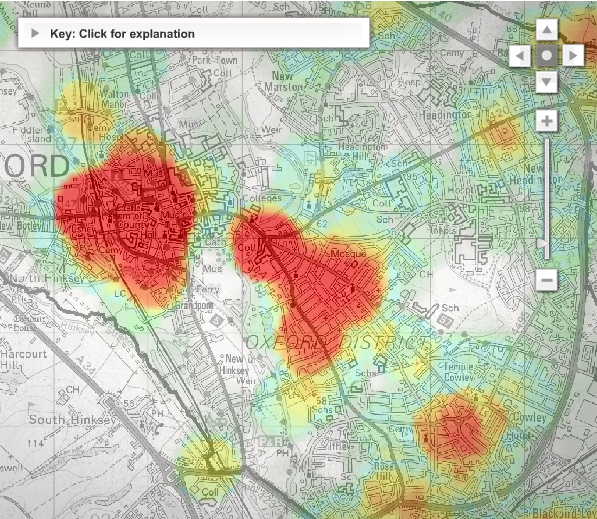
Mentorn Media and Cimex Media, on behalf of BBC, explore crime patterns in Oxford over time. In a map, that I am happy to see is not a Google mashup, select different kinds of crime (e.g. violent crime, burglary & theft), or if you live in the area, compare different neighborhoods by postcode. The interactive also provides three animations for a week in crime – street violence, street robbery, and rowdy behavior – complemented by narration and explanation.
One thing I’m not so sure about is the color scale. I think I would have gone with a yellow to red progression and left out the green since green usually means something positive. I’m also not sure what ‘high’ and ‘low’ levels of crime actually means in numbers. What do you think?
[Thanks, Jack]
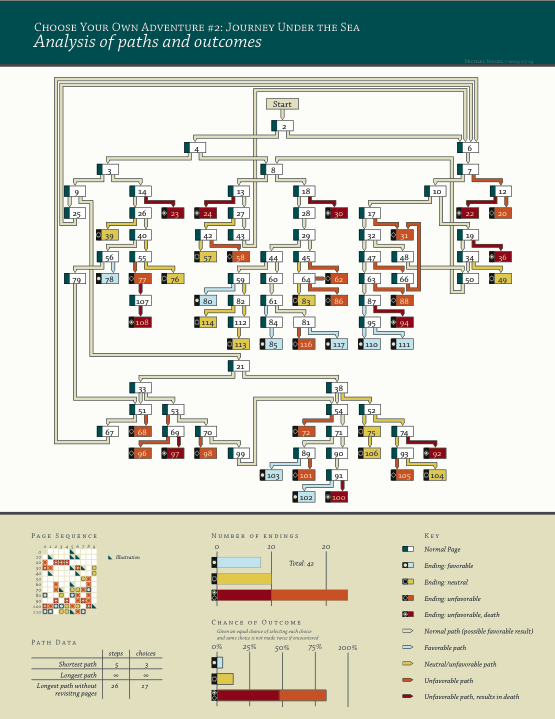
Remember those choose your own adventure
Michael Niggel of Hazard Creative took a look at Journey Under the Sea, and mapped out all possible paths. It turns out that death and unfavorable endings are in fact much more likely than the rest.
That somehow seems wrong, no? I liken it to something like… even in your own fantasy, you die or end with an unfavorable outcome. Such is life, I suppose.
View the full-size version here [PDF].
[Thanks, Michael]
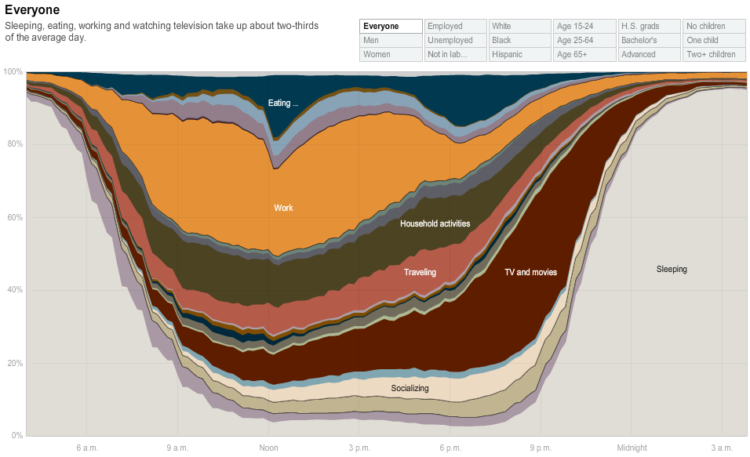
From Shan Carter, Amanda Cox, Kevin Quealy, and Amy Schoenfeld of The New York Times is this new interactive stacked time series on how different groups in America spend their day. The data itself comes from the American Time Use Survey. The interactive has a similar feel to Martin Wattenberg’s Baby Name Voyager, but it has the NYT pizazz that we’ve all come to know and love.
Read More
We all know this already, but it’s nice to get some backing from The New York Times every now and then. In this NYT article, that I’m sure has spread to every statistician’s email inbox by now, Steve Lohr describes the dead sexy that is statistics:
The rising stature of statisticians, who can earn $125,000 at top companies in their first year after getting a doctorate, is a byproduct of the recent explosion of digital data. In field after field, computing and the Web are creating new realms of data to explore sensor signals, surveillance tapes, social network chatter, public records and more. And the digital data surge only promises to accelerate, rising fivefold by 2012, according to a projection by IDC, a research firm.
I’ve got about one more year (hopefully) until I finish graduate school. Hmm, things are looking up, yeah? Of course, it’s never been about the money. The profession of statistician didn’t nearly seem so hot when I started school. The best news here is that us data folk are going to get paid for doing what we enjoy, and as time goes on there’s only going to be more data to play with, and we’re going to be in high demand:
Yet data is merely the raw material of knowledge. “We’re rapidly entering a world where everything can be monitored and measured,” said Erik Brynjolfsson, an economist and director of the Massachusetts Institute of Technology’s Center for Digital Business. “But the big problem is going to be the ability of humans to use, analyze and make sense of the data.”
Wait, but it’s not just statisticians who can interpret data:
Though at the fore, statisticians are only a small part of an army of experts using modern statistical techniques for data analysis. Computing and numerical skills, experts say, matter far more than degrees. So the new data sleuths come from backgrounds like economics, computer science and mathematics.
Like a… data scientist? Excellent.
It’s been about three weeks since I announced the new version of your.flowingdata (YFD), and I’m pleased with how things have progressed. We’ve seen over 21,000 data points tweeted by all of you. Very cool.
People are tracking lots of different aspects of their lives including diet, bodily functions, and bad habits. Someone is tracking their child’s new words while another is recording who he meets up with. Some have written scripts to automate their data logging. It’s beautiful, really. Tear.
This is of course still the beginning though. There are a lot of things in the works and many features planned. I’ve got a long to-do list.
In this first set of updates we’ve got:
Your data is still private, but now you can share some of it with others with custom pages. The way it works is you have access to modules that you can organize the way you want on your page. Make the page public and then share the URL.
I’ve created a health page (above) for myself. Other users have made pages for caloric consumption, reading, t-shirt colors, glucose levels, morale and productivity, and drug intake among plenty of other stuff.
Another benefit of custom pages, other than sharing, is that they let you create custom views into your data that you can check in on with a single click. You can make your pages private too.
I think reminders might be the most requested feature from new YFD users. Well, here you go. Data logging takes a little bit of getting used to in the beginning, so you can set reminders for yourself. Set the number of days you’re allowed to go without tweeting any data. If you pass the threshold, YFD will send (DM) you a friendly reminder.
Finally, I’ve put together more help on how to use your.flowingdata, namely a searchable FAQ. I based a lot of the new help docs on questions and feedback you guys asked and left in the forums. Hopefully, it makes things much more clear.
If you’re interested in recording your life in data, it’s easy to get started with YFD:
(Hopefully Twitter has recovered from the denial-of-service attack by the time this post goes up.)
As usual, all comments and questions are welcome below or in the your.flowingdata forum.
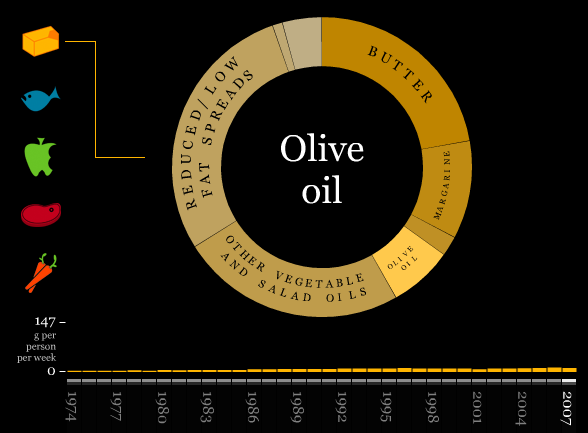
The Department for Environment, Food and Rural Affairs (DEFRA) keeps an archive of what British citizens have consumed over the years. The Times Online, in collaboration with designer Marcin Ignac, visualizes this data in their recent interactive. Consumption is by grams with a percentage breakdown up top with the donut chart, and a weekly average (for each year) on the bottom. The donut chart updates when you scroll over a bar in the time series chart. Very nice work I think. What do you think?

From William Couch, Kristen Novak, Michelle Price and Joshua Hatch of USA Today, this tracker tool lets you compare ratings of past current and past presidents according to Gallup polls.
Read More
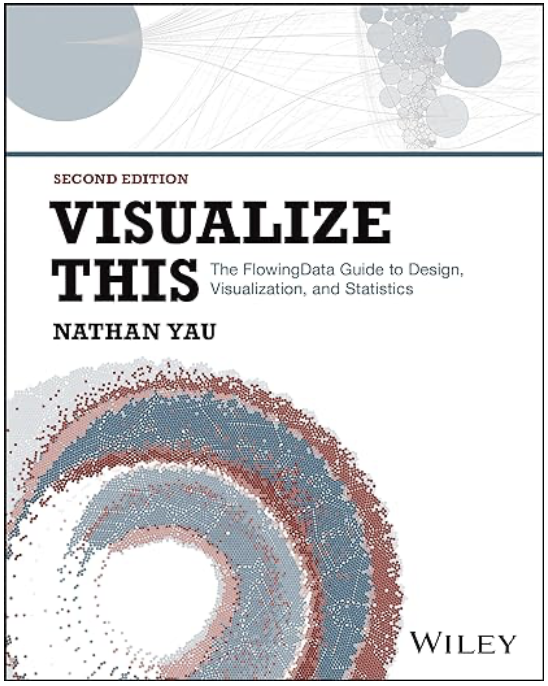 Visualize This: The FlowingData Guide to Design, Visualization, and Statistics (2nd Edition)
New tools, refined process.