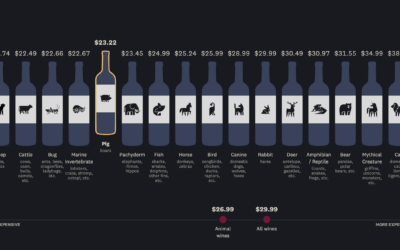
Designers' current obsession with cocktails and proportions continues with Konstantin Datz' recent poster. Engineer's guide to drinks is still the best. Although this one gets plus points for hints of realism.
Continue Reading
Designers' current obsession with cocktails and proportions continues with Konstantin Datz' recent poster. Engineer's guide to drinks is still the best. Although this one gets plus points for hints of realism.
Continue Reading
I found this on Serious Eats, but it looks like it's from a book. Anyone know what book it is? This picture is awesome. Maybe one day, with enough practice, sweat, and tears, you will be able to tame the breath of the dragon.
Continue Reading
Amusing from graphic designer Joe Stone, although not as good as the crazy-detailed one from a couple of years ago. [Joe Stone | Thanks, John]
Aww, how cute. As a birthday gift, a couple sent their best wishes to a friend overseas via deconstructed cupcake graphic.
Okay, it's kind of a given for why we need to make sure great teachers keep teaching America's children. If you've had a great teacher, you know what I mean. If you've had a bad teacher, you know what I mean. StudentsFirst argues for the end of last in, first out, which is a firing policy based on seniority. If teachers are going to be fired, the last teachers hired have to go first.
Continue Reading
In response to Sarah Palin's complaints about gas prices around four dollars per gallon, GOOD, in collaboration with Dylan Lathrop and Sara Saedi, takes a look at other things priced per gallon. They probably could've done more to show a sense of scale, but the list works fine here, too.
Randall Munroe of xkcd, with the help of a friend who is senior reactor operator, puts radiation dose in perspective:
I’m not an expert in radiation and I’m sure I’ve got a lot of mistakes in here, but there’s so much wild misinformation out there that I figured a broad comparison of different types of dosages might be good anyway. I don’t include too much about the Fukushima reactor because the situation seems to be changing by the hour, but I hope the chart provides some helpful context.
Start at the top left (sleeping next someone), to the right, and then down (standing next to the Chernobyl reactor core after explosion and meltdown) for increasing levels of radiation and warnings.
Continue Reading
A Visual Compendium of Notable Haircuts in Popular Music from Pop Chart Lab has a look at, well, haircuts. Lots of long hair and sideburns.
From the pompadour to the moptop to the metal mane to whatever it is Lady Gaga has atop her head, here is a history of popular music as told through the notable haircuts on this signed, limited edition print.
If you pre-order a print by this weekend, you get 20 percent off.
See also Beatles hair history, trustworthiness of beards, and typographic moustaches.
[Pop Chart Lab via Laughing Squid]
Mozilla tech evangelist Paul Rouget has a go at Internet Explorer 9 in a series of simple graphs, comparing it to Firefox 4. I think Rouget doesn't like IE9. Not sure though.
The obvious progression of this series is to compare Firefox 4 to Chrome and Safari. I await the results.
Greg Ross highlights an old school graphic from The Strand Magazine, published in 1906. Authors are sized by how much the public read his or her work at the time.
The giant is Dickens, followed by Thackeray and the now largely forgotten Hall Caine. Lesser mortals, left to right, are Thomas Hardy, Mary Elizabeth Braddon, Marie Corelli, Rudyard Kipling, Mary Augusta Ward, J.M. Barrie, Arthur Conan Doyle, Stanley Weyman, Robert Louis Stevenson, Walter Scott, Henry James, Charlotte Brontë, George Meredith, Anthony Trollope, Charles Kingsley, Edward Bulwer-Lytton, Israel Zangwill, Charles Reade, and E.F. Benson.
I'm guessing that the drawing is subjective, or did they have data on book sales back then?
[Futility Closet | Thanks, Craig]
Continuing their series on world population, National Geographic focuses in on the "most typical" person in the world. The above image is an artist's rendering of the average face computed by the Chinese Academy of Sciences in Beijing. Zoom in and you'll see that the face is made of 7,000 human figures, as shown below. It's true. I counted.
Continue Reading
If you love baseball and have an iPad, you need Pennant, a project by Steve Varga. The app lets you explore every game and play since 1951. See the numbers for your favorite player or team with just a few taps or swipes while you're plopped on your couch watching the game. Imagine: one hand with an ice cold beverage, iPad on your lap, and the game on in front of you.
Continue Reading
I can't resist. It's about food and those chickens are just so cute. View the full guide to eggs on culinaut.
Here's something to chew on while you wait for the 2011 slam dunk contest to get a move on already. It's a score history of all of the dunks from 1984 to 2010, complete with video. From the commentator after Michael Jordan's first dunk in round 3 in 1988: "I like to call that the Chinese Superman dunk. He goes in slanted."
[Hoopism via @infochimps]
Designer Gregor Aisch has a look at energy usage in Europe. Click on a number of topics on the bottom to see how each country compares, or mouse over a specific country to get its details. Bubbles are color-coded according to relatively high or low levels (I think) and sized by population (I think). There isn't a whole lot of explanation of what you're actually seeing, but it has some interesting interactions in there. Maybe our European readers can add some context. Don't forget to take it fullscreen and put it on autoplay.
[publicdata.eu via @moritz_stefaner]
I think we've all grown accustomed to this by now. Designer Nicholas Felton, known for his quantified annual reports on his life for the past year, just put up his Report for 2010. This one though isn't for Nicholas. It's for his late father. It's breakdowns for where he lived and traveled, postcards sent, and people he spent time with.
Continue Reading
Designer Ibraheem Youssef iconifies the most viewed YouTube videos of all time. Do you recognize what each icon represents? I'm embarrassed to say that I probably know one too many of them.
Continue Reading
Fortune Magazine recently published their annual list of top companies to work for, with SAS, Boston Consulting, and Wegman's taking the one, two, and three spots, respectively. To accompany the piece, this interactive, produced by Tommy McCall, shows what the employees have to say about their companies.
Continue Reading
Even Bill Gates has an infographics section. In his 2011 annual letter, Gates focuses on Polio and vaccines, and uses graphics to highlight spots. Most of them have to do with the decrease in number of Polio cases and increase in vaccine coverage, but there's one graph that I gave a double take. It shows the correlation between IQ and disease burden. Question of the day: if we decrease disease burden in a country by improving healthcare (or availability of vaccines), will the country as a whole become smarter, or are better educated people generally healthier?
[Gates Foundation | Thanks, Michael]
I post this graphic by Muller on the Coen brothers filmography mostly because, well, of the Coen brothers filmography. I also kind of like the name. Main characters are shown from most recent on down and connecting lines show previous Coen films that actor was in.
[Muller | Thanks, Thomas]