
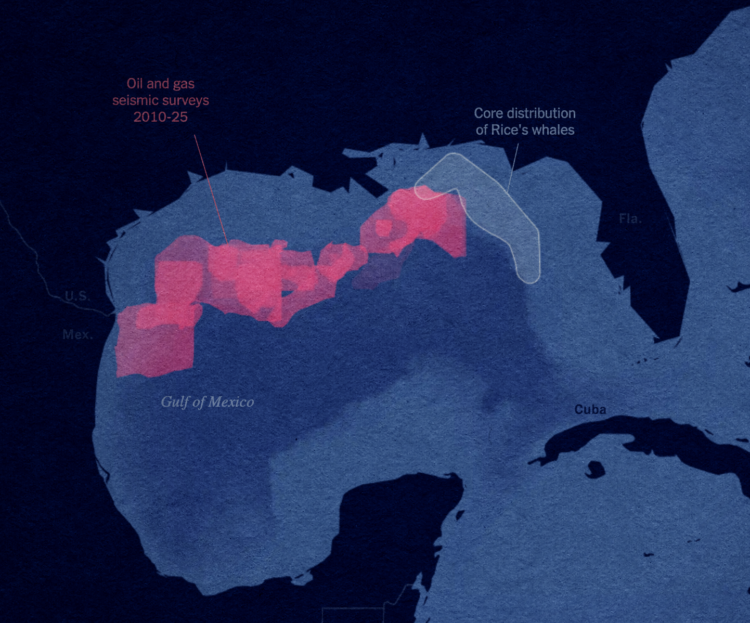
Companies use seismic airguns in the Gulf of Mexico to find oil and gas deposits. The airguns deliver air blasts in the water, and the time it takes for an echo to return can be used to estimate metrics on the seabed.
For the New York Times, Katherine Chui and Catrin Einhorn demonstrate, with visualization and audio, how the waves from the airguns interfere with whale communication.
The Gulf of Mexico, which the Trump administration calls the Gulf of America, is one of the noisiest bodies of water in the United States. Air gun blasts are the loudest element there, according to research by scientists who monitor underwater acoustics. Shipping traffic is another major contributor.
The noise could affect the ability of Rice’s whales to find food and mates, scientists say. The chronic stress of living in a loud environment could be detrimental to their health.
The maps, graphics, and sounds combine well to emphasize the problem.
 Visualize This: The FlowingData Guide to Design, Visualization, and Statistics (2nd Edition)
