
Randal Heeb convinced a New York City judge that poker isn’t a game of luck, using a 120-page report full of analysis and charts.
Judge Weinstein, relying on the research of Randal Heeb – an economist, statistician and poker player – found that while luck determines what cards a player gets, skill plays the bigger role in a player’s ultimate success. With such charts as “Win-Rate Comparison: King Nine Offsuit,’ the 91-year-old judge delved into the complexities of the argument more thoroughly than any past court has. John Pappas was pleased with the result, and impressed with the methodology.
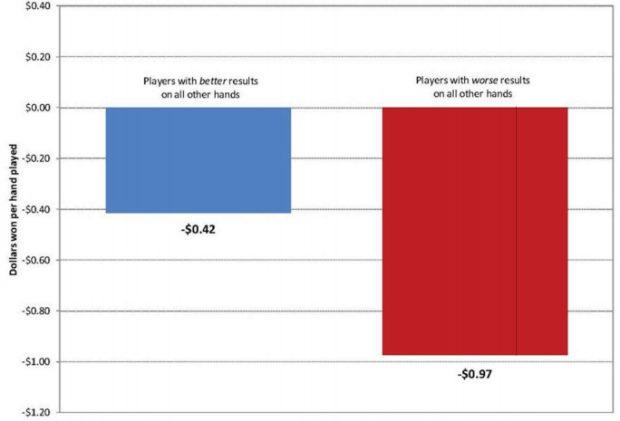
The king nine offsuit chart he refers to is above. Simulated earnings for better players are shown on the left in blue, and earnings for not so good players are shown on the right. Although both groups are likely to lose with the hand, skill appears to decrease expected losses.
Check out the full report here [pdf].
 Visualize This: The FlowingData Guide to Design, Visualization, and Statistics (2nd Edition)

This study is very interesting, but I find figure 6 (probability of win for the good player against the bad one vs. nb of hands in the game) much more easy to interpret than the one you showed. The good player being the average one in the first half, the bad the average one in the second half.
What this graph shows is that in the very long term, the good player win and the bad player loose. But everyone would have guessed that, right?
What is interesting is to note that it takes quite a lot of time: 1000 hands, so 30 hours, to reach a 90% probability to win. And after just 3 hours, it seems that the probability to win is only about 65%.
So for a professional player, poker is skills, not luck. But for a given evening playing poker, it still seems to be to a large extent a matter of luck.
These statistics are not about ONE EVENING of poker. The argument that poker is a game of skill (which it is) uses the premiss of a CAREER of consistent poker playing. This helps set the precedent that tradition gambling laws should not be used in relation to poker, as it is not based in chance, but in skill with some elements of chance.
No professional including the great Phil Ivey can beat the luckiest poker player on earth. Just ask Chris Moneymaker. And when you’re unlucky you can be Phil Ivey and still lose (never won a WSOP main event). Math is idiotic in poker because 99% chance to win means absolutely nothing…. just means you’ll witness a sick suckout.