
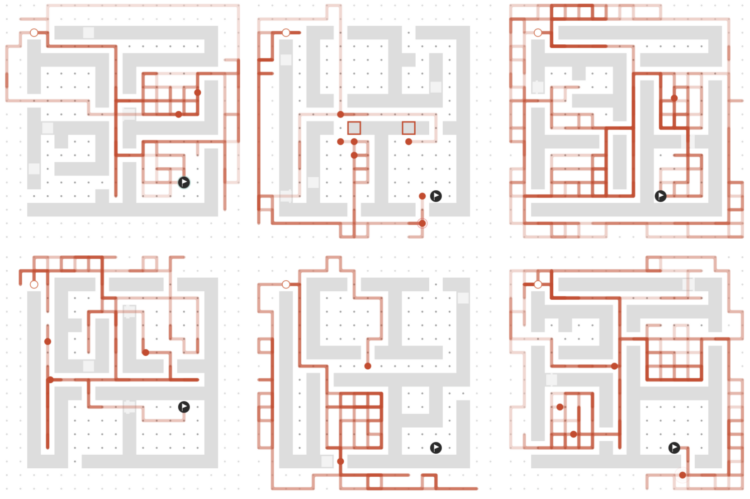
For the New York Times, Raj Saha and Blacki Migliozzi used mazes to demonstrate how AI models are trained and how agents complete tasks in unexpected ways. Some argue the double-edged sword:
At the same time, he said, agents can’t be safely contained if they are given the tools and access they need to be useful. “An inconvenient truth about developing frontier A.I. systems is that minimizing safety risks and maximizing legitimate utility are incompatible objectives,” Dr. Casper said. “The same agent that is good at helping biologists debug lab experiments could also be misused for constructing biohazards. In this sense, building ever more capable A.I. systems is somewhat of an inherently dangerous activity.”
Call me crazy, but if the large companies are held financially and socially liable for the models they distribute, I suspect the companies might find a way to block “rogue” behavior.
Ethics aside, the mazes in this piece are a good illustration of how the AI gets made. I paused at each one to watch the simulations play through.
 Visualize This: The FlowingData Guide to Design, Visualization, and Statistics (2nd Edition)
