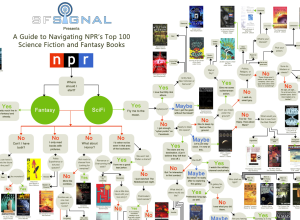
SF Signal constructs a big arse flowchart to help you sift through NPR's listener-picked top 100 science fiction and fantasy books. It's big and scrolltastic. Check out full and printable version here. I end up at The Time Machine by Wells. You?
2011 September
-
Flowchart: Which of NPR’s top 100 science fiction and fantasy books should you read?
-
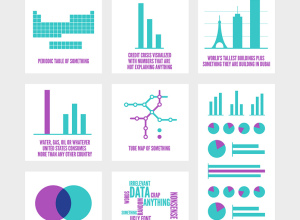
Most popular infographics generalized
Yep, still amusing. [via]
-
The Many Words for Visualization
There are a lot of words to describe visualization and visualization-related things. It can be confusing. You just came across this thing with data and stuff, but what do you call it? Here I define what all those words mean. Keep in mind, I'm not so, uh, good with words and, uh, stuff, so yeah.
Disclaimer: This is how I perceive the words. They are not official dictionary or academic definitions. Don't use these in your next report or paper, unless you want to be laughed at.
Continue Reading -
Live data wall and immersive film at THINK exhibit
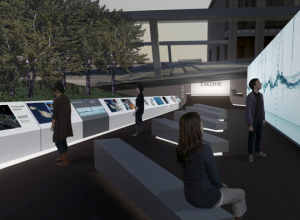
The THINK exhibit from IBM just opened up at Lincoln Center in New York, complete with data wall and immersive film. The former visualizes surrounding data in real-time, such as traffic, solar energy, and air quality. The formers puts you in a place with 40 seven-foot screens.
Continue Reading -
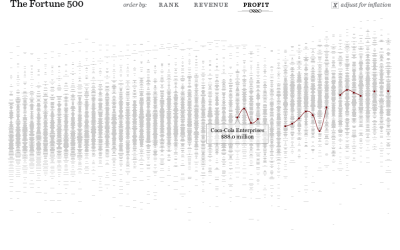
The Fortune 500, 1955 to 2010
Since 1955, Fortune Magazine has published a list of America's 500 largest companies. What companies have risen to the top? Which ones have fallen? Ben Fry, of Fathom Information Design, visualizes the companies of past and present and how their rankings, revenue, and profit have changed.
Continue Reading -
Deleted Geocities archive visualized as city
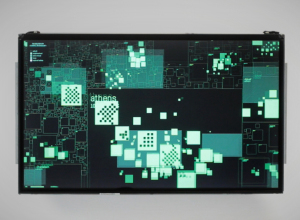
In a time long ago, there existed a place on the Internet called Geocities. People created pages and pages of blinking icons, brightly colored background, and everyone loved it. There was even MIDI music to set the mood. In 2009, Geocities was deleted, but the memories lived on thanks to the Archive Team. Information designer Richard Vijgen visualized these pages in an interactive piece called The Deleted City.
Continue Reading -
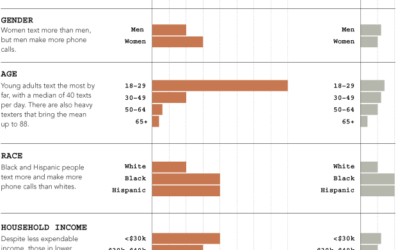
Who does all the text messaging? Young adults by far.
The Pew Internet and American Life Project published the results of their texting study, showing that young adults text more... -
5 misconceptions about visualization
Last month, I had the pleasure of spending a week at the Census Bureau as a "visiting scholar." They're looking to boost their visualization efforts across all departments, and I put in my two cents on how to go about doing it. For being a place where there is so much data, the visual side of things is still in the early stages, generally speaking.
During all the meetings, there were recurring themes about what visualization is and what it is used for. Some people really got it, but others were new to the subject, and we ran into a few misconceptions that I think are worth repeating.
Here we go, in no particular order.
Continue Reading -
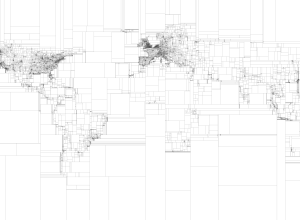
Rectangular subdivisions of the world
Eric Fischer, who continues his string of mapping fun and doesn't even do it for his day job, maps the world in binary subdivisions. Each bounding box contains an equal number of geotagged tweets. Continue Reading
-
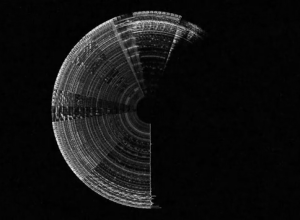
Musical spectrum analysis
Jon-Kyle Mohr visualizes the musical spectrum of a song in this mesmerizing video. As the song plays, frequencies bubble up in the 6-o-clock position, and the trace remains as the circle rotates.
[Video Link via feltron]
-
Imager shows cross-sections of everyday objects – analog version
GE shows how their body imaging technology can take detailed pictures of insides without cutting, using fruit, a baseball, engine motor, and violin to demonstrate.
Many body imaging devices follow a principle called tomography (the 'T' in CT, PET and SPECT systems), which take images of body "slices" using everything from projection data to powerful magnets. But have you ever wondered how such routine procedures can help clinicians see things that used to require a sharp knife? Watch how GE's body imaging technology can paint a bigger picture of what’s happening beneath our skin.
Update: I wasn't paying close enough attention, and it turns out that these are actual, physical sliced objects. Like, with a saw. Now I'm left wondering what the point is.
-
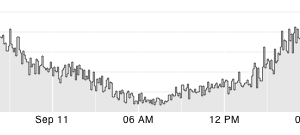
Quick time series visualization with Cube
Seeing how things change over time can be important for a business so that you can figure out what works best. Square, the company that turns your iPhone into a credit card reader, just released Cube, an open-source system to help you visualize time series data. It's built on MongoDB, Node, and D3.
Continue Reading -
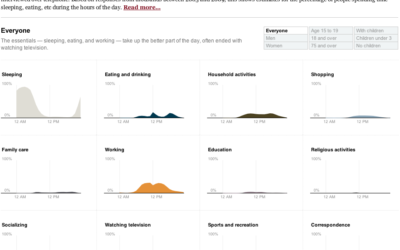
How do Americans spend their days?
One of my favorite data graphics is an interactive piece by The New York Times that shows how Americans spend... -
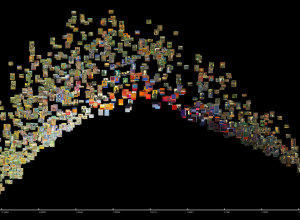
Explore large image collections with ImagePlot
When we make charts and graphs, we usually think of the data abstractions in terms of bars, dots, and other geometric shapes. ImagePlot, from UCSD-based Software Studies, instead makes it easier to use images to understand large collections.
Continue Reading -
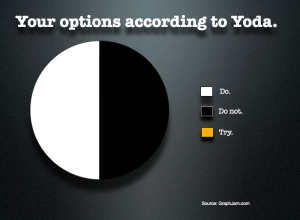
Yoda pie chart
"Do or do not. There is no try." — Yoda [via]
-
World population densities mapped
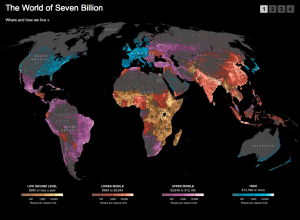
National Geographic has a look at where and how we live:
The map shows population density; the brightest points are the highest densities. Each country is colored according to its average annual gross national income per capita, using categories established by the World Bank (see key below). Some nations — like economic powerhouses China and India — have an especially wide range of incomes. But as the two most populous countries, both are lower middle class when income is averaged per capita.
It's interesting, but the map is a little wonky, because the income levels and population densities differ in granularity. It kind of works. Kinda doesn't. There seems to be a lot of missing data — or does population density in northern Africa really drop off that quickly (it is desert land, albeit)? A little more explanation in the description or the legend would have been useful.
Continue Reading -
Smart people talk about art and data
A few months ago, a packed crowd gathered in Minneapolis for the Eyeo Festival to hear some of the best in data art, visualization, and creative code talk about what they do and how they do it. I didn't get a chance to go, but from all the chatter online during the event (and the stellar speaker lineup), I get the sense I missed something good. Luckily, some of the talks are available online.For starters, Ben Fry and Casey Reas talk about Processing, their grad school grown programming language; Aaron Koblin presents some of the work from the Google Data Arts team; and Nicholas Felton discusses the process behind his annual reports.
Catch a few more on the Eyeo Vimeo channel or to stay updated for when new videos are uploaded.
-
BBC Knowledge
This is totally sunshine and lollipops, but it has a good flow to it, and well, I totally wanted to know more about BBC Knowledge. Too bad it's not available in my region that is America.
[Video Link via datavisualization]
-
PDF data woes
We do not provide these tables in Excel or CSV format. You will have to cut and paste from the pdf.
— A government group that provides a lot of dataIf you're going to provide a dataset to the public, or anyone for that matter, please don't use PDF as your one and only format. At the very least, provide it in Excel. You can easily export spreadsheets to PDF. I don't hold anything against the person who sent me this message. She was just doing her job. But organizations need to get with the times and provide data in a way that is actually usable.
-
The United Kingdom of McDonald’s
In a follow-up to his ever popular McMap that showed distance to the nearest McDonald's in the United States, Stephen Von Worley does the same for the United Kingdom and Ireland.
Continue Reading


The Best Data Visualization Projects of 2011
What Facebook knows about you
Where are the biggest box office movies (not) streaming?
High-resolution maps of science
Backbone of the flavor network
Vehicles involved in fatal crashes
Cinemetrics creates a visual fingerprint for movies
Visualize This